Table of Contents
Toyota RAV4 Snow Mode: The Complete Guide to Winter Driving Safety and Performance
Winter driving transforms familiar roads into unpredictable challenges where traction vanishes, stopping distances multiply, and vehicle control becomes precarious. A momentary lapse in attention or inappropriate throttle input can send even experienced drivers sliding helplessly across ice-slicked pavement. For the millions of Toyota RAV4 owners living in regions experiencing winter weather—from the snow belt stretching across northern states to mountain communities worldwide—understanding vehicle capabilities in low-traction conditions isn’t merely academic knowledge but potentially life-saving information.
The Toyota RAV4 Snow Mode represents Toyota’s engineering response to winter driving challenges, employing sophisticated electronic systems to optimize traction, stability, and control when road surfaces offer minimal grip. Unlike the simple four-wheel-drive systems of previous generations that merely split power between axles, modern Snow Mode integrates throttle management, transmission control, brake-based traction management, and all-wheel drive torque distribution into a coordinated system specifically calibrated for slippery surface driving.
Yet despite Snow Mode’s availability across most RAV4 trim levels, many owners remain uncertain about its functionality, appropriate usage, and actual benefits compared to normal driving modes. Questions persist: Does Snow Mode really improve winter safety? When should it be activated? How does it interact with all-wheel drive systems? Does it work with two-wheel drive models? What are its limitations?
This comprehensive guide explores Toyota RAV4 Snow Mode in complete technical detail—from the specific electronic systems it modifies to the physics of winter traction, from proper activation procedures to advanced driving techniques, from understanding its capabilities to recognizing its limitations. Whether you’re a new RAV4 owner preparing for your first winter with the vehicle, an experienced driver seeking to optimize winter performance, or a prospective buyer evaluating the RAV4’s winter capabilities, this article provides the depth needed to understand, utilize, and trust Snow Mode as a valuable tool for safe winter driving.
Understanding Winter Driving Challenges
The Physics of Reduced Traction
Traction—the friction between tires and road surface enabling acceleration, turning, and braking—decreases dramatically on snow and ice compared to dry pavement. Dry asphalt typically provides coefficient of friction around 0.7-0.9, meaning tires can generate lateral or braking forces approaching the vehicle’s weight. Packed snow reduces this to approximately 0.2-0.3, while ice can drop to 0.1-0.15—an 80-90% traction reduction.
This traction loss fundamentally alters vehicle behavior. Stopping distances on ice can be ten times longer than dry pavement—what required 60 feet on dry roads may need 600 feet on ice. Acceleration capability drops proportionally; throttle applications that produced smooth acceleration on dry pavement now overwhelm available traction, causing wheel spin. Cornering limits decrease severely; turns negotiated confidently at 30 mph on dry roads may induce sliding at 15 mph on ice.
Hydroplaning on slush presents additional challenges beyond simple friction reduction. Thick slush can’t be displaced quickly enough by tires at highway speeds, causing tires to ride on slush layer rather than contacting pavement. This complete traction loss differs from reduced friction—no amount of electronic traction control helps when tires aren’t touching road surface. Reducing speed through slush and avoiding sudden inputs becomes critical.
Black ice—transparent ice forming on pavement that appears merely wet—represents particular danger because drivers don’t recognize reduced traction until attempting to brake, accelerate, or turn. The seemingly wet road provides visual feedback suggesting adequate traction, causing drivers to maintain speeds and inputs appropriate for wet pavement but catastrophically excessive for ice.
How Vehicles Lose Control on Slippery Surfaces
Understeer occurs when front tires lose grip during cornering, causing vehicles to continue straight despite steering input. Front-wheel-drive vehicles like base RAV4 models are particularly prone to understeer because front wheels must simultaneously steer and provide driving force. Excessive throttle application while cornering can overwhelm front tire traction, causing understeer that no amount of additional steering corrects.
Oversteer happens when rear tires lose grip, causing the rear to slide outward in corners. While less common in front-wheel-drive and all-wheel-drive RAV4s than rear-wheel-drive vehicles, oversteer can occur during trail-braking (braking while cornering) or when abruptly lifting throttle mid-corner causing weight transfer off rear tires. Oversteer requires opposite steering input (countersteering) to correct—often counterintuitive for drivers unused to slides.
Brake lockup occurs when braking force exceeds available traction, causing wheels to stop rotating while the vehicle continues sliding. Locked wheels provide virtually no steering control or braking effectiveness, with skidding tires offering less friction than rolling tires. Anti-lock braking systems (ABS) prevent lockup through rapid brake pressure modulation, maintaining wheel rotation and steering control even during emergency stops on ice.
Wheel spin during acceleration wastes power while providing minimal acceleration and potentially causing directional instability. Spinning drive wheels can’t generate forward thrust, with energy instead dissipating as heat and tire wear. On snow-covered roads, aggressive wheel spin can melt snow creating slippery water layer reducing traction further. Additionally, differential wheel speeds between left and right tires can cause vehicles to veer unpredictably.
Traditional vs. Modern Winter Driving Approaches
Traditional four-wheel-drive systems simply engaged all wheels mechanically, distributing power between front and rear axles. While providing improved traction over two-wheel drive on slippery surfaces, these systems couldn’t prevent individual wheels from spinning, didn’t reduce excessive power application, and offered no throttle management assistance. Drivers needed significant skill to modulate throttle smoothly enough to maintain traction without wheel spin.
Modern electronically-controlled AWD systems with modes like Snow Mode represent fundamental advances in winter driving safety and capability. These systems don’t merely distribute power but actively manage it through integrated control of throttle response, transmission behavior, brake-based traction control, and torque distribution. The result is systems that help drivers maintain control even when making inputs that would cause slides in vehicles lacking electronic management.
What Toyota RAV4 Snow Mode Actually Does
Comprehensive System Integration
Snow Mode in the Toyota RAV4 represents sophisticated coordination of multiple electronic systems working together to optimize vehicle behavior for low-traction conditions. Understanding the specific changes Snow Mode implements helps drivers appreciate both its capabilities and limitations.
Throttle response modification represents Snow Mode’s most immediately noticeable change. The aggressive, responsive throttle mapping used in Sport Mode or even Normal mode can too easily overwhelm available traction on snow or ice. Even small pedal movements can request more power than slippery surfaces allow, causing wheel spin and loss of control.
Snow Mode implements gentler throttle progression, reducing sensitivity to initial pedal inputs. The same pedal position that might produce 50% throttle in Normal mode might yield only 20-25% in Snow Mode. This reduced sensitivity makes fine-tuning throttle application easier, helping drivers provide just enough power to move without overwhelming traction. The flatter throttle curve essentially provides more “resolution” for low-throttle operation where winter driving primarily occurs.
Additionally, Snow Mode may limit maximum throttle opening even at full pedal travel—preventing drivers from requesting maximum power that would certainly break traction. While this limitation might seem restrictive, it actually helps maintain control during moments of panic or misjudgment when instinct might command full throttle despite conditions warranting restraint.
Transmission behavior changes help maintain traction through gear selection strategies. In Normal or Sport modes, transmissions typically start from first gear, which provides maximum torque multiplication—ideal for quick acceleration but potentially overwhelming for slippery surfaces. Snow Mode often instructs the transmission to start from second gear, reducing torque at the wheels and making smooth departure from stops easier without wheel spin.
During acceleration, Snow Mode maintains higher gears longer compared to Normal mode’s tendency to downshift for performance. This reduced engine speed and torque delivery helps prevent breaking traction during acceleration. The transmission also shifts more smoothly with gentler clutch or torque converter engagement, avoiding the abrupt power delivery changes that can upset traction.
Traction control system calibration changes represent Snow Mode’s most technically sophisticated adjustments. Modern traction control systems use individual wheel speed sensors to detect when one wheel spins faster than others—indicating lost traction. When detected, the system can reduce engine power and apply brakes to the spinning wheel, transferring torque to wheels with better grip.
Snow Mode adjusts traction control intervention thresholds and strategies. While Normal mode might allow 5-10% wheel slip before intervention, Snow Mode might tolerate 10-15% slip—recognizing that some slip is necessary for maintaining forward momentum in deep snow where tires must somewhat paddle through rather than rolling on firm surface. The intervention timing and severity also change, with Snow Mode using more gradual power reduction rather than aggressive intervention that could cause abrupt deceleration.
The brake-based torque vectoring employed by traction control operates more frequently in Snow Mode. When one wheel loses traction, the system applies brake to that wheel while maintaining or increasing power to the other wheel. This effectively creates a limited-slip differential action, preventing power from simply flowing to the spinning wheel while ensuring the wheel with traction receives usable power.
All-Wheel Drive Integration
For AWD-equipped RAV4 models, Snow Mode modifies all-wheel drive system behavior to optimize traction distribution. The RAV4’s AWD system (available as standard equipment on many trims, optional on others) uses an electronically-controlled coupling transferring power from front to rear axle based on driving conditions.
In Normal mode, the RAV4 AWD system operates primarily in front-wheel-drive for efficiency, engaging rear wheels when front wheel slippage is detected or during acceleration where additional traction would help. This reactive approach works well for dry pavement but may allow momentary front wheel spin on slippery surfaces before rear engagement occurs.
Snow Mode proactively engages AWD, pre-distributing power to rear wheels before front slip occurs. Rather than waiting for front wheels to spin, the system assumes low traction and maintains some power delivery to all four wheels continuously. This proactive strategy improves traction during acceleration while also providing better vehicle stability through power distribution to all wheels.
Some RAV4 models equipped with Dynamic Torque Vectoring AWD (standard on Adventure, TRD Off-Road, and Limited trims in recent years) gain additional capabilities in Snow Mode. This advanced system can disconnect the rear driveshaft entirely for maximum efficiency when AWD isn’t needed, then rapidly engage it when conditions demand. It can also distribute torque independently to left and right rear wheels, improving cornering traction and stability.
In Snow Mode, Dynamic Torque Vectoring AWD maintains more aggressive rear axle engagement and uses more active torque vectoring to optimize individual wheel traction. The system may also coordinate with traction control more closely, using torque distribution changes to complement brake-based traction management.
Two-Wheel Drive Model Considerations
Base RAV4 models with front-wheel drive only still benefit from Snow Mode, though the capabilities differ from AWD versions. Without rear axle power distribution capability, FWD Snow Mode focuses primarily on throttle management, transmission control, and front-wheel traction control optimization.
The gentler throttle progression and second-gear starts prove particularly valuable on FWD models where all acceleration forces must come through front wheels. Front-wheel drive inherently challenges winter traction because front tires must simultaneously provide steering control and acceleration forces—each demand competing for limited available traction.
Snow Mode helps FWD RAV4s manage this front-tire workload through conservative power delivery that avoids overwhelming front traction. The transmission’s tendency to maintain higher gears also helps by reducing torque at the wheels. While FWD Snow Mode can’t match AWD capabilities—physics limits any FWD vehicle compared to AWD on slippery surfaces—it significantly improves FWD winter performance compared to Normal mode operation.
What Snow Mode Doesn’t Do
Understanding Snow Mode’s limitations is crucial for safe winter driving. Snow Mode is not a substitute for appropriate tires, safe speeds, increased following distances, or driver skill and judgment.
Snow Mode does not increase available traction. The fundamental friction between tires and road surface determines ultimate vehicle capability—Snow Mode can only optimize how vehicle systems utilize whatever traction exists. Ice remains ice whether Snow Mode is active or not; the physics of coefficient of friction don’t change based on electronic settings.
Snow Mode does not enable fast driving on snow or ice. While optimizing vehicle behavior for slippery conditions, Snow Mode cannot overcome basic physics limiting safe speeds. Cornering forces, braking distances, and acceleration capability remain severely limited by reduced traction regardless of drive mode selection.
Snow Mode does not replace winter tires. All-season tires lose significant performance below 40°F due to rubber compound hardening, reducing grip even before considering snow or ice. Winter tires maintain flexibility at low temperatures and use tread designs optimized for snow traction—providing fundamentally better grip that Snow Mode can’t replicate through electronic systems alone.
Snow Mode does not guarantee preventing getting stuck. Deep snow, steep inclines, or truly inadequate traction can stop any vehicle regardless of electronic assistance. Snow Mode improves chances of maintaining momentum and minimizing wheel spin but cannot guarantee forward progress in all conditions.
How to Activate and Use Toyota RAV4 Snow Mode
Step-by-Step Activation Process
Activating Snow Mode in your Toyota RAV4 is straightforward, though specific interfaces vary by model year and trim level. For most recent RAV4 generations (2019-present), follow these steps:
1. Start your RAV4 and allow the engine to complete its startup routine. Snow Mode can be activated immediately after starting, though allowing brief warm-up before driving in any severe conditions protects mechanical components.
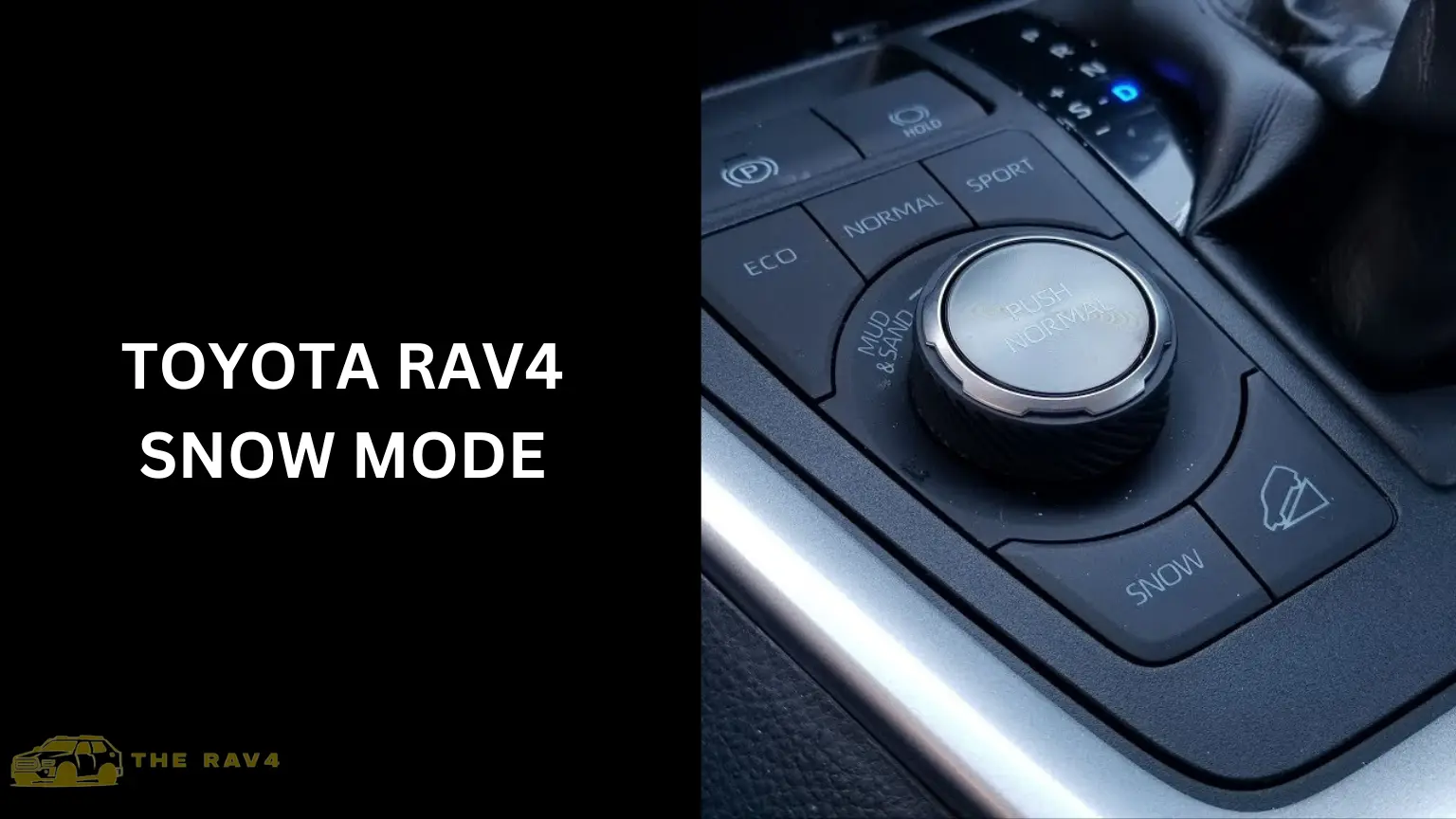
2. Locate the drive mode selector or Multi-Terrain Select dial on the center console. The exact location and interface type varies: some models use a rotary dial near the gear selector, others use push-button interfaces, and some integrate mode selection into the infotainment touchscreen.
3. Select Snow Mode by rotating the dial to the snowflake icon or pressing the button labeled “Snow” or marked with a snowflake symbol. If your RAV4 has Multi-Terrain Select (available on Adventure, TRD Off-Road, and some Limited trims), you may need to first enter the MTS system then select Snow from the available terrain modes.
4. Confirm activation through the instrument cluster display. The multi-information display will show “SNOW” or display a snowflake icon confirming Snow Mode is active. Some models also illuminate a dedicated indicator light on the instrument panel.
5. Begin driving carefully, recognizing that even with Snow Mode active, traction remains limited. Use gentle inputs initially to assess actual traction levels before committing to acceleration, braking, or cornering maneuvers.
When to Activate Snow Mode
Preemptive activation works best—engage Snow Mode before encountering slippery conditions rather than after traction problems begin. Once a vehicle starts sliding or wheels begin spinning, correcting the situation becomes more difficult than preventing it through proper setup.
Recommended activation scenarios include:
- Before leaving home when snow, ice, or slush covers roads
- When entering mountain passes or areas with winter conditions
- Before freezing rain or winter storms arrive
- Any time temperatures drop below freezing and moisture is present
- When roads appear wet but temperatures suggest possible ice formation
Leave Snow Mode active throughout journeys when conditions remain wintry rather than repeatedly switching modes. The system changes aren’t harmful during momentary dry pavement sections, and keeping it active ensures readiness when slippery sections return unexpectedly.
Deactivation and Mode Persistence
Snow Mode remains active until manually deselected or the engine is shut off. Most RAV4 model years do not remember Snow Mode selection after restart—requiring reactivation each time you start the vehicle. This intentional design prevents drivers from forgetting Snow Mode is active when conditions improve, avoiding the gentler throttle and transmission behavior limiting performance on dry pavement.
Switching to other modes can be done while driving without stopping. If road conditions improve—entering a city where streets are cleared, transitioning to dry highways, or simply finding traction has improved—feel free to switch back to Normal or Eco mode. The transition occurs gradually without abrupt changes in vehicle behavior.
In some model years, leaving Snow Mode engaged on dry pavement may display warning messages suggesting switching to more appropriate modes. This is the vehicle’s computer recognizing that wheel speeds, throttle positions, and driving patterns don’t match expected behavior for true snow conditions—a helpful reminder but not an indication of problems.
Advanced Usage Techniques
Combining Snow Mode with manual transmission control (where available) can further optimize traction. Some drivers prefer manually selecting higher gears than Snow Mode’s automatic selection would choose, further reducing torque at wheels. The transmission’s manual mode or sequential shift function allows this control while maintaining Snow Mode’s other benefits.
Using Snow Mode with Downhill Assist Control (DAC, available on Adventure and TRD Off-Road models) provides maximum control on steep, slippery descents. DAC automatically modulates brakes maintaining controlled descent speed, while Snow Mode’s gentle throttle prevents inadvertent acceleration. This combination proves particularly valuable on steep, winding mountain descents with ice or packed snow.
Coordinating Snow Mode with cruise control requires caution. Adaptive cruise control systems maintain speed through throttle and brake application, but they don’t understand traction limitations. On slippery roads, cruise control may request more throttle than conditions allow, potentially causing traction loss. Many experienced winter drivers avoid cruise control entirely on snow-covered roads, preferring direct manual control even with Snow Mode active.
Driving Techniques for Winter Conditions with Snow Mode
Fundamental Winter Driving Principles
While Snow Mode optimizes vehicle systems, safe winter driving ultimately depends on proper technique and judgment. Snow Mode assists good driving; it cannot compensate for inappropriate speeds, aggressive inputs, or poor decisions.
Smooth inputs are paramount on slippery surfaces. Abrupt throttle, brake, or steering changes can overwhelm available traction causing slides. All inputs—accelerating, braking, turning—should be gradual and deliberate, giving tires time to build forces within traction limits. Think of driving on ice as though your passengers were holding full cups of coffee you don’t want spilled—this mental model encourages the smoothness winter driving requires.
Reduced speeds below posted limits become necessary on snow-covered roads. Speed limits assume dry pavement; winter conditions may require 50% reductions or more depending on severity. As a general guideline, many driving experts recommend halving your normal speed on snow-covered roads, reducing to one-third on ice. These reductions aren’t cautious overreactions—they reflect the real traction limitations physics imposes.
Increased following distances account for dramatically extended stopping distances. The standard “three-second rule” for following distance on dry roads should expand to six seconds or more on snow, potentially ten seconds on ice. This additional space provides time to react to sudden stops while allowing gradual braking that won’t overwhelm traction.
Anticipating far ahead enables early, gentle responses rather than emergency reactions. Scan well beyond your immediate path—200-300 feet ahead on city streets, quarter-mile or more on highways—identifying potential hazards early enough for gentle corrective inputs. Anticipation eliminates surprises requiring harsh reactions that cause traction loss.
Starting from Stops Without Wheel Spin
Gentle throttle application from stops represents one of winter driving’s most basic yet critical skills. Snow Mode’s reduced throttle sensitivity helps, but drivers must still exercise restraint. Apply throttle gradually until you feel the vehicle begin moving, then maintain steady pressure rather than continuing to increase it.
If wheels begin spinning, immediately reduce throttle rather than applying more trying to power through. Wheel spin is counterproductive—spinning tires can’t generate forward thrust, with energy instead wasted melting snow or polishing ice. Release throttle until wheels regain traction, then retry with even gentler application.
For particularly difficult starts—steep hills, deep snow, ice—consider these techniques:
- Rock gently back and forth, using momentum from small movements to break free
- Straighten wheels rather than turning while accelerating (reduces traction demand)
- Remove some air from tires (modestly, to perhaps 5 psi below normal) increasing contact patch
- Ensure AWD is engaged by briefly driving forward before attempting difficult start
- Place weight over drive wheels if possible (FWD: nothing in trunk; AWD: evenly distributed)
Starting in second gear, which Snow Mode often does automatically, reduces torque at wheels making smooth departure easier. If your transmission has manual mode, consider manually selecting second gear for extremely slippery starts.
Braking Safely on Slippery Surfaces
Threshold braking—applying maximum brake pressure just short of ABS activation—provides shortest stops on surfaces with adequate traction. However, on ice or packed snow where ABS activates immediately, simply applying firm steady pressure and allowing ABS to modulate provides optimal results.
The pulsing pedal feedback when ABS activates feels unusual and may trigger instinct to reduce brake pressure. Resist this urge—maintain firm pedal pressure and allow ABS to work. The pulsing sensation indicates ABS is rapidly modulating brake pressure to individual wheels, maintaining wheel rotation and steering control while maximizing available braking.
Engine braking by downshifting helps control speed on long descents without overheating friction brakes. Snow Mode’s transmission behavior somewhat limits engine braking compared to Sport or Normal modes, but manually selecting lower gears (if transmission has manual mode) provides additional engine braking when needed.
Avoid braking while cornering whenever possible. Cornering already consumes most available traction; adding braking demands can overwhelm grip causing slides. Reduce speed before curves through early, gentle braking on straight approaches, then maintain steady throttle through corners.
Cornering Without Sliding
Reduced cornering speeds beyond what seems necessary often prove appropriate on ice. Corners negotiated comfortably at 40 mph on dry roads may require 15-20 mph on ice—a humbling reduction, but physics doesn’t compromise. Entering corners too fast on slippery surfaces provides no safe recovery—better to approach conservatively.
Trail-braking—continuing gentle braking into corner entry—can improve vehicle balance and control for experienced drivers but risks inducing slides if done too aggressively. For most drivers, completing braking before turn-in and maintaining steady throttle throughout corners provides safest approach.
Smooth steering inputs without abrupt changes help maintain traction. Turn steering wheel gradually at corner entry, maintain steady input through corner, and unwind steering gradually at exit. Rapid steering changes can exceed front tire traction limits causing understeer (continuing straight despite turning input).
If understeer occurs—vehicle continues straight despite steering input—resist instinct to turn steering more. Instead, slightly reduce steering input and gently reduce throttle, allowing front tires to regain grip. Adding more steering when already understeering doesn’t help; front tires are already working at their traction limit.
If oversteer occurs—rear begins sliding outward—apply opposite steering (countersteering) to catch the slide while simultaneously applying gentle throttle if AWD-equipped. For FWD models, straighten steering and gently apply throttle, allowing front wheels to pull vehicle straight. These corrections require practice to execute smoothly—consider taking winter driving courses to develop these skills safely.
Climbing Hills Without Losing Momentum
Momentum management proves critical for hill climbing on slippery surfaces. Assess hill conditions before committing—can you see the top, are there stopped vehicles partway up, what’s road condition? If uncertain, avoid attempting difficult climbs without escape plans.
Maintain steady speed while climbing rather than accelerating mid-hill. Build sufficient speed on flat approach to carry momentum up the hill, then maintain steady throttle throughout ascent. Avoid slowing unnecessarily, as regaining lost momentum risks wheel spin.
If wheels begin spinning on hills, immediately reduce throttle and try to regain traction while maintaining any remaining momentum. If stuck, don’t continue spinning wheels—this only polishes the surface making recovery more difficult and risks overheating drivetrain components.
For difficult climbs, ensure AWD is fully engaged by briefly accelerating hard before the hill (on safe flat section) to force AWD coupling into maximum engagement. This preloading ensures rear wheels receive power from the climb’s beginning rather than engaging only after front wheels slip.
Descending Hills Safely
Engine braking provides best control for downhill descents on ice or snow. Manually select lower gears (second or third gear depending on steepness) before beginning descent, using engine compression to control speed rather than riding brakes. This prevents brake overheating on long descents while providing steady, predictable speed control.
Gentle brake application supplements engine braking when needed. Avoid hard braking that might trigger ABS or lock wheels—gentle pressure provides better control and allows steering inputs if needed. If ABS activates during downhill braking, maintain pressure but recognize that ice or packed snow provides minimal braking—extended stopping distances are inevitable.
Downhill Assist Control (DAC), available on Adventure and TRD Off-Road RAV4 models, automates descent control on steep grades. When activated, DAC automatically modulates brakes to maintain slow, controlled descent speed (typically around 3-5 mph) without driver brake input. Combined with Snow Mode, DAC provides maximum control for steep, slippery descents.
If vehicle begins sliding downhill, avoid panic braking which could induce spins. Instead, gently reduce brake pressure if ABS is pulsing violently, maintain straight steering if possible, and allow vehicle to slow gradually. Sliding on downhills often results from brake lockup—paradoxically, reducing braking slightly can restore control.
Comparing Snow Mode to Other RAV4 Drive Modes
Snow Mode vs. Normal Mode
Normal mode calibrates vehicle systems for balanced everyday performance on dry or slightly wet pavement. Throttle response is reasonably responsive, transmission shifts for efficiency and performance balance, and traction control intervenes only during significant wheel slip.
On winter roads, Normal mode’s calibrations can prove too aggressive. The responsive throttle makes avoiding wheel spin from stops more difficult. The transmission’s tendency to use lower gears and downshift readily can deliver more torque than slippery surfaces accommodate. Traction control calibrated for dry pavement may not intervene quickly or smoothly enough for ice.
Snow Mode addresses these deficiencies through gentler throttle, conservative transmission behavior, and traction control optimized for slippery surfaces. The result is noticeably easier winter driving with reduced wheel spin, better traction, and enhanced stability. For true winter conditions, Snow Mode provides clear advantages over Normal mode.
Snow Mode vs. Eco Mode
Eco mode prioritizes fuel efficiency through even gentler throttle progression than Snow Mode, early upshifts, and minimized electrical accessory loads. These characteristics might seem beneficial for winter driving, and Eco mode’s gentle throttle does help prevent wheel spin on moderately slippery surfaces.
However, Eco mode’s calibrations optimize efficiency rather than traction. Traction control and AWD engagement strategies remain as in Normal mode rather than Snow Mode’s low-traction optimizations. The transmission’s eagerness to upshift—helpful for efficiency—can prove problematic on ice where maintaining slightly lower gears helps engine braking and traction.
Snow Mode should be preferred over Eco mode whenever road conditions present traction challenges, despite Eco mode’s gentler throttle potentially helping moderately. Snow Mode’s comprehensive system optimizations specifically target slippery conditions rather than Eco mode’s efficiency-focused calibrations that happen to share some beneficial characteristics.
Snow Mode vs. Sport Mode
Sport mode represents the worst choice for slippery conditions—aggressive throttle mapping, transmission holding lower gears aggressively, and calibrations prioritizing performance over smooth control. Sport mode’s characteristics directly oppose what winter driving requires: gentle inputs, conservative power delivery, and predictable, stable behavior.
The aggressive throttle response in Sport mode makes avoiding wheel spin nearly impossible on ice or snow. Even tiny pedal movements request substantial power, overwhelming traction immediately. The transmission’s tendency to hold low gears provides maximum torque—excellent for performance but excessive for slippery surfaces.
Never use Sport mode on snow or ice unless you’re an experienced driver intentionally inducing slides in controlled environments (empty parking lots) to practice vehicle control. For actual transportation on winter roads, Sport mode creates dangerous unpredictability and should be avoided entirely.
Snow Mode vs. Multi-Terrain Select Modes (Mud & Sand, Rock & Dirt)
RAV4 models equipped with Multi-Terrain Select (MTS)—primarily Adventure and TRD Off-Road trims—offer additional modes beyond Snow: Mud & Sand, Rock & Dirt, and sometimes a dedicated Trail mode. Understanding how these relate to Snow mode helps optimize RAV4 capability.
Mud & Sand mode shares some characteristics with Snow mode—gentle throttle, traction control allowing some wheel slip—but calibrated for surfaces where some aggressive tire slip helps propulsion (mud, sand) rather than pure slippery conditions where slip provides no benefit. For most winter road conditions, Snow mode’s calibrations prove more appropriate than Mud & Sand.
Rock & Dirt mode optimizes for low-speed technical terrain requiring precise throttle control and maximum traction to all wheels. While potentially useful for packed snow or ice in parking lots requiring very slow maneuvering, Rock & Dirt mode isn’t calibrated for normal winter driving speeds and should be reserved for off-road use.
Trail mode (when available) attempts balancing on-road and off-road capabilities—more aggressive than Snow mode but less extreme than Rock & Dirt. For mixed conditions—plowed roads with some unplowed sections—Trail mode might provide versatile compromise, though pure snow-covered roads still benefit most from dedicated Snow mode.
Selecting Optimal Modes for Specific Conditions
Light snow on paved roads: Snow Mode provides appropriate balance of traction management and drivability.
Heavy, deep snow: Mud & Sand mode’s tolerance for wheel slip may help in deep snow requiring some paddling action, though Snow Mode typically suffices.
Icy roads: Snow Mode’s conservative calibrations prove optimal, with gentler inputs than even MTS modes provide.
Slushy conditions: Snow Mode helps manage unpredictable traction variations as wheels transition between slush, pavement, and standing water.
Mixed conditions (some snow, some clear): Snow Mode enables safe operation across all conditions without frequent mode changes.
Mountain passes: Snow Mode for ascents and descents, potentially combined with manual gear selection for extended downhill engine braking.
Winter Tire Considerations and Snow Mode
The Critical Importance of Proper Tires
While Snow Mode optimizes vehicle systems, tires represent the only contact between vehicle and road—making tire choice absolutely critical for winter safety. All-season tires lose significant performance below 40°F due to rubber compound hardening, reducing grip even on dry pavement. On snow and ice, all-season tires provide minimal traction compared to dedicated winter tires.
Winter tires use rubber compounds remaining flexible at low temperatures, maintaining grip when all-seasons harden. Tread patterns optimize snow traction through sipes (small slits in tread blocks), deeper voids for snow evacuation, and designs that pack snow into tread (snow-on-snow contact provides better traction than rubber-on-snow). The performance difference exceeds what many drivers expect—winter tires can reduce stopping distances by 30-40% compared to all-seasons in winter conditions.
The combination of Snow Mode and winter tires provides exponentially better capability than either alone. Snow Mode can optimize how vehicle systems utilize traction, but it cannot create traction that doesn’t exist. Winter tires provide the fundamental grip Snow Mode needs to work with. Together, they create capability far exceeding all-seasons with Snow Mode or winter tires without Snow Mode.
All-Terrain Tire Considerations
Some RAV4 owners, particularly those with Adventure or TRD Off-Road models, choose all-terrain tires for enhanced off-road capability and rugged appearance. These tires use more aggressive tread patterns than all-seasons with deeper voids and larger tread blocks.
For winter conditions, all-terrain tires provide mixed results. The aggressive tread can help in deep snow through better evacuation and edge effects. However, most all-terrain tires use rubber compounds optimized for durability and off-road traction rather than low-temperature flexibility—meaning they still harden in cold weather reducing grip on ice and hard-packed snow.
Some manufacturers now offer winter-rated all-terrain tires carrying the Three-Peak Mountain Snowflake (3PMSF) symbol indicating certified winter traction performance. These specialized tires provide genuine winter capability while maintaining off-road characteristics—an excellent choice for RAV4 owners prioritizing year-round versatility.
Tire Pressure Monitoring
Tire pressure drops approximately 1 psi for every 10°F temperature decrease. A tire properly inflated to 35 psi at 70°F in summer will read around 30 psi at 20°F in winter—a 15% pressure loss potentially triggering tire pressure monitoring system (TPMS) warnings.
Proper winter tire pressure matters for both safety and performance. Underinflated tires reduce handling precision, increase stopping distances, and risk damage from impacts or curbs. However, some winter driving situations benefit from slightly reduced pressure—modestly lower pressure (2-3 psi below normal) increases contact patch size, potentially improving traction in deep snow.
For typical winter driving, maintain manufacturer-specified tire pressures (found on driver’s door jamb sticker) adjusted for current ambient temperature. Check pressures monthly and before long trips, recognizing that cold weather significantly affects readings. Adjust pressures when temperatures change dramatically—both seasonal transitions and short-term cold snaps.
Maintenance Considerations for Winter RAV4 Operation
Preparing Your RAV4 for Winter
Preventive maintenance before winter arrives helps ensure reliable operation during challenging conditions. Key preparations include:
Battery testing: Cold weather stresses batteries; marginal batteries that start acceptably in summer may fail in winter when cold increases required cranking power while simultaneously reducing battery capacity. Test battery condition in fall, replacing if showing weakness.
Coolant system inspection: Verify antifreeze mixture provides adequate protection for lowest temperatures expected. Test with refractometer or hydrometer, adjusting mixture if necessary to protect to -30°F or lower. Inspect hoses for cracks or deterioration that could cause failures in cold weather.
Wiper blade replacement: Worn wiper blades that streak in rain become completely ineffective in snow. Replace blades annually before winter, considering winter-specific blades with rubber boots preventing ice accumulation on blade frames.
Washer fluid upgrade: Replace summer washer fluid with winter formulations rated to -30°F or colder. Summer fluid freezes in reservoirs and lines, potentially cracking components while leaving you unable to clear windshields during winter driving.
Engine oil consideration: Modern synthetic oils maintain proper viscosity across wide temperature ranges, but very cold climates may warrant switching to 0W-20 or thinner oils for easier cold starting and immediate oil circulation. Consult owner’s manual for approved viscosities.
Undercarriage protection: Road salt and brine accelerate corrosion on chassis, suspension, and exhaust components. Consider professional undercoating or frequent undercarriage washing to remove salt accumulation, particularly if keeping vehicle long-term in salt-belt regions.
Operating Considerations in Extreme Cold
Remote starting (if equipped) proves valuable in extreme cold, allowing cabin and engine warming before driving. However, extended idling wastes fuel and generates emissions—10-15 minutes of warm-up suffices for most conditions. Modern engines don’t require extensive warm-up; gentle driving immediately after starting actually warms engines faster than idling.
Fuel level maintenance: Keep fuel tanks at least half-full during winter. Beyond providing safety margin if stranded, fuller tanks reduce condensation accumulation in fuel systems. Additionally, gasoline’s energy density provides potential heat source if truly stranded—running engine periodically for warmth.
Emergency equipment: Maintain winter emergency kit including blankets, flashlight, first aid kit, jumper cables, tow strap, shovel, ice scraper, and non-perishable food/water. For backcountry travel, add sleeping bag, additional warm clothing, fire-starting materials, and emergency communication device.
Post-Winter Maintenance
Thorough cleaning after winter removes corrosive road salt from vehicle surfaces. Focus particularly on wheel wells, undercarriage, door jambs, and any areas where salt or slush accumulated. Professional detailing with underbody wash proves worthwhile for preserving vehicle long-term.
Suspension and brake inspection: Road impact from potholes and rough pavement (common after freeze-thaw cycles) can damage suspension components. Have suspension geometry checked and components inspected for damage. Inspect brake pads, rotors, and caliper hardware for excessive wear or corrosion from winter use.
Tire changeover: When consistently above 40-45°F, switch back to all-season or summer tires. Winter tires wear quickly on warm pavement while providing less precise handling than tires designed for warm conditions. Store winter tires properly—clean, dry location away from sunlight and ozone sources.
Real-World Owner Experiences and RAV4 Winter Capability
Owner Testimonials and Reviews
RAV4 owners across snow-belt regions consistently report positive experiences with Snow Mode and overall winter capability. Common themes from owner forums, reviews, and testimonials include:
Confidence in snow: Multiple owners note Snow Mode’s contribution to confident winter driving, with particular praise for gentle throttle progression preventing wheel spin and AWD engagement providing excellent traction in moderate snow.
Limitations acknowledged: Experienced winter drivers recognize Snow Mode improves but doesn’t eliminate winter driving challenges. Deep snow, steep hills, or true ice still present difficulties requiring appropriate tires, careful driving, and sometimes acceptance that conditions exceed safe limits.
Comparison to previous vehicles: Owners upgrading from older vehicles or competitors often highlight RAV4’s winter capability improvements. The combination of modern AWD, Snow Mode, and electronic stability systems provides substantially better winter performance than basic four-wheel-drive systems or vehicles lacking drive mode optimization.
Learning curve: Some owners report initial uncertainty about Snow Mode usage but growing appreciation through experience. First-time Snow Mode users sometimes don’t notice dramatic differences until encountering truly challenging conditions where the mode’s benefits become obvious.
Scenario-Based Performance Examples
Midwest suburban winter driving: RAV4 AWD with Snow Mode and winter tires navigates typical snow-belt conditions—3-6 inch snowfalls, occasional ice, cold temperatures—with excellent confidence and minimal drama. Commuting, errands, and general transportation proceed normally with appropriate speed reductions.
Mountain pass winter travel: RAV4 Adventure with Snow Mode, winter tires, and Dynamic Torque Vectoring AWD handles mountain highways and passes with good capability, though severe storm conditions or unplowed roads may exceed prudent limits. Downhill Assist Control proves particularly valuable on steep descents.
New England ice storm conditions: Widespread ice challenges all vehicles, with RAV4’s Snow Mode helping manage intermittent traction but unable to overcome physics of ice friction. Extreme caution, reduced speeds, and recognition of limits proves necessary regardless of vehicle capability.
Colorado ski resort access: RAV4 handles typical ski resort access roads acceptably with proper tires and Snow Mode, though truly challenging conditions (steep unplowed roads, deep accumulation) may warrant more capable vehicles or tire chains.
Canadian Prairie winter: Extended extreme cold (-20°F to -40°F), wind-blown snow, and occasional whiteout conditions require comprehensive winter preparedness beyond Snow Mode alone. RAV4 proves mechanically reliable and capable when properly maintained and equipped.
Comparative Capability Assessment
While RAV4 provides excellent winter capability for a compact crossover, understanding its position relative to other vehicles helps set realistic expectations:
Versus subcompact crossovers: RAV4’s size, weight, and available AWD provide advantages over smaller competitors like Honda HR-V, Mazda CX-30, or Subaru Crosstrek in deep snow where ground clearance and weight help. Snow Mode sophistication matches or exceeds smaller competitors.
Versus midsize crossovers: Larger vehicles like Honda Pilot, Toyota Highlander, or Subaru Ascent provide additional ground clearance and weight potentially helping in deep snow but offer similar AWD technology and drive mode capabilities as RAV4.
Versus dedicated winter-focused vehicles: Subaru Outback or Wilderness models, Jeep Wrangler, or full-size trucks with four-wheel drive provide superior capability in extreme conditions through greater ground clearance, more aggressive AWD systems, or traditional four-wheel drive with low-range gearing.
Versus luxury crossovers: Premium competitors like Audi Q5, BMW X3, or Volvo XC60 may offer more sophisticated AWD systems and additional drive modes but command substantial price premiums for incrementally better winter capability.
For most winter driving scenarios—plowed roads with snow accumulation, icy patches, typical winter storms—the RAV4 with Snow Mode and proper tires provides entirely adequate capability at accessible price points. Extreme conditions or specific off-road winter scenarios may warrant more specialized vehicles, but typical suburban and highway winter driving suits RAV4 capabilities well.
Conclusion: Maximizing Winter Safety and Capability
Toyota RAV4 Snow Mode represents sophisticated engineering addressing the challenges of winter driving through coordinated electronic system optimization. By modifying throttle response, transmission behavior, traction control calibration, and all-wheel drive engagement, Snow Mode creates vehicle behavior specifically tailored for slippery surfaces—dramatically improving driver’s ability to maintain traction, stability, and control in challenging conditions.
Yet Snow Mode’s effectiveness depends critically on understanding both its capabilities and limitations. Snow Mode optimizes vehicle systems, but it cannot create traction where none exists or enable safe operation at inappropriate speeds. The fundamental physics of ice and snow—reduced friction, extended stopping distances, limited cornering grip—remain unchanged regardless of electronic assistance. Snow Mode helps drivers work within these constraints more effectively but cannot eliminate them.
The most important winter safety factors actually lie outside Snow Mode itself. Proper winter tires provide the fundamental grip all electronic systems require to function effectively. Appropriate speeds reflecting actual road conditions prevent exceeding traction limits. Smooth driving inputs avoid overwhelming available grip. Adequate following distances account for extended stopping distances. Anticipatory driving enables early, gentle responses rather than emergency reactions. Snow Mode enhances these fundamentals but cannot substitute for them.
For RAV4 owners in winter climates, developing comprehensive winter driving competence requires moving beyond simply activating Snow Mode. Invest in quality winter tires—the single most important winter safety upgrade. Practice smooth driving techniques in safe environments like empty parking lots before applying them in traffic. Maintain realistic expectations about vehicle capabilities and road conditions. Prepare emergency equipment for unexpected situations. Most importantly, recognize that sometimes conditions exceed safe limits regardless of vehicle capability, and declining to drive represents the safest choice.
Snow Mode provides RAV4 owners with a valuable tool optimizing their vehicle’s winter performance and enhancing safety during challenging conditions. Combined with proper tires, appropriate driving techniques, and sound judgment, Snow Mode enables confident, capable winter driving that transforms potentially stressful experiences into merely routine cold-weather transportation. Understanding and properly utilizing Snow Mode represents important knowledge for millions of RAV4 owners navigating winter conditions annually.
Additional Resources
For RAV4 owners seeking additional winter driving information and capability optimization:
- Your Toyota RAV4 Owner’s Manual provides specific information about your model year’s Snow Mode implementation and winter driving recommendations
- The National Highway Traffic Safety Administration offers winter driving safety guidance applicable across all vehicles
- Consumer Reports publishes comprehensive winter tire testing and recommendations helping identify optimal tire choices for specific needs and budgets
- RAV4World and RAV4 owner forums provide peer experiences, regional winter driving advice, and practical tips from thousands of RAV4 owners navigating winter conditions
- Local winter driving courses offer hands-on skill development in controlled environments, dramatically improving winter driving confidence and capability