Table of Contents
Toyota RAV4 Trail Mode: Complete Guide to Off-Road Capability and Performance
The Toyota RAV4 has been a popular choice among SUV enthusiasts for its versatility and reliability, consistently ranking among the best-selling compact SUVs in America. While many buyers appreciate the RAV4 for its practicality and fuel efficiency, there’s a growing segment of owners who want more—specifically, the ability to confidently venture beyond paved roads and explore trails, fire roads, and challenging terrain.
One of the standout features that addresses this desire is the RAV4’s Trail Mode, designed to enhance off-road capabilities and provide a thrilling driving experience in rugged terrain. But what exactly is Trail Mode? How does it work? Which RAV4 models have it? And most importantly—does it actually make a difference when you’re navigating a muddy forest road or climbing a rocky trail?
This comprehensive guide answers all these questions and more, providing everything you need to know about Toyota RAV4 Trail Mode: what it does, how to use it effectively, which models offer it, how it compares to competitors’ systems, real-world performance insights, and tips for maximizing its capabilities. Whether you’re a current RAV4 owner curious about that button on your dashboard or a prospective buyer wondering if the Adventure or TRD Off-Road trim is worth the upgrade, this guide provides the detailed information you need.
Introduction to Toyota RAV4 Trail Mode
Toyota introduced the Trail Mode as part of its commitment to delivering exceptional off-road performance without compromising on comfort and safety. This feature is available in select RAV4 models and has garnered praise from adventure seekers and outdoor enthusiasts who appreciate having genuine off-road capability in a vehicle that remains civilized for daily driving.
The Evolution of RAV4 Off-Road Capability
The RAV4 wasn’t always considered an off-road vehicle. Early generations (1996-2012) were primarily designed as car-based crossovers focused on practicality and fuel economy. While they featured available all-wheel drive, their capability on challenging terrain was limited.
The Shift Toward Adventure (2013-2018): The fourth generation RAV4 introduced the Adventure grade, signaling Toyota’s recognition that many buyers wanted more rugged capability. However, true Trail Mode didn’t arrive until the fifth generation.
Fifth Generation Revolution (2019-Present): The 2019 RAV4 redesign brought dramatic changes, including:
- More aggressive styling with higher ground clearance
- Dynamic Torque Vectoring AWD on select models
- Introduction of Multi-Terrain Select (which includes Trail Mode)
- TRD Off-Road model with enhanced capability
Which RAV4 Models Have Trail Mode?
Trail Mode is not available on all RAV4 models. Here’s the breakdown:
Models WITH Trail Mode (2019+):
- RAV4 Adventure (AWD) – Standard equipment
- RAV4 TRD Off-Road (AWD) – Standard equipment
- RAV4 Limited (AWD) – Standard equipment
Models WITHOUT Trail Mode:
- RAV4 LE (base model)
- RAV4 XLE
- RAV4 XLE Premium
- RAV4 Hybrid (any trim)
- RAV4 Prime (plug-in hybrid)
Important Note: Even RAV4 models without Trail Mode still have capable AWD systems. Trail Mode simply provides additional optimization for specific off-road conditions.
What Makes Trail Mode Different?
Trail Mode isn’t just a marketing gimmick—it’s a sophisticated electronic system that actively manages multiple vehicle functions simultaneously to optimize traction and control in specific off-road conditions. It’s part of Toyota’s Multi-Terrain Select (MTS) system, which offers different modes for different surfaces.
What is Toyota RAV4 Trail Mode? Technical Deep Dive
Trail Mode is an advanced driving setting specifically tailored for off-road conditions. It optimizes the vehicle’s traction control, throttle response, and braking system to navigate challenging terrains such as mud, sand, and gravel with ease.
How Trail Mode Works: The Technical Details
When you activate Trail Mode, the RAV4’s computers make multiple coordinated adjustments:
Traction Control System Modifications:
- Increased Wheel Slip Tolerance: Normal traction control cuts power at the first sign of wheel slip. Trail Mode allows controlled wheelspin, which is essential for digging through mud, sand, or loose gravel to find traction underneath.
- Power Distribution: Works with Dynamic Torque Vectoring AWD to send power to the wheels with the most grip.
- Reduced Intervention: System allows more driver control before electronic aids intervene.
Throttle Response Adjustment:
- Progressive Power Delivery: Throttle input becomes more gradual and predictable, preventing abrupt wheel spin.
- Low-Speed Control: Enhanced throttle modulation at speeds under 5 mph for precise rock crawling or obstacle navigation.
- Prevents Wheel Hop: Smooth power delivery reduces harsh wheel hop on uneven terrain.
Braking System Optimization:
- Brake Lock Differential (BLD): Applies brakes to slipping wheels, transferring torque to wheels with traction.
- Hill Descent Control Integration: Works seamlessly with HDC for controlled descents.
- ABS Calibration: Anti-lock braking thresholds adjusted for loose surfaces.
Transmission Behavior:
- Holds Lower Gears: Transmission maintains lower gears longer for better control.
- Reduced Shift Frequency: Fewer gear changes prevent momentum loss on obstacles.
- Engine Braking: Enhanced engine braking on descents.
Dashboard Indicators:
- Visual confirmation of Trail Mode activation
- Real-time display of which wheels are receiving power
- Inclinometer showing vehicle pitch and roll angles
The Science Behind Trail Mode
Why Allow Wheelspin?
This seems counterintuitive—doesn’t wheelspin mean loss of traction? In on-road situations, yes. But off-road, controlled wheelspin is essential:
Digging Through Soft Surfaces: On sand or mud, tires must spin to dig down to firmer ground underneath.
Momentum Maintenance: Slight wheelspin maintains forward momentum through soft spots.
Heat Generation: Spinning tires on snow/ice can melt surface layer, improving grip.
Cleaning Tread: Wheelspin clears mud from tire treads, restoring traction.
Trail Mode’s sophisticated algorithms allow the optimal amount of wheelspin for conditions while preventing excessive spin that wastes momentum.
Dynamic Torque Vectoring AWD: Trail Mode’s Foundation
Trail Mode’s effectiveness depends on Toyota’s Dynamic Torque Vectoring All-Wheel Drive (DTV-AWD) system available on Adventure, TRD Off-Road, and Limited models.
How DTV-AWD Works:
Front-to-Rear Distribution: Can send up to 50% of power to rear wheels (more than standard AWD’s 35%).
Rear Differential Torque Vectoring: This is the key feature—individual rear wheels can receive different amounts of power.
Disconnect Mechanism: During highway cruising, rear driveshaft disconnects completely to improve fuel economy.
Instant Engagement: Rear wheels re-engage in milliseconds when needed.
Why Torque Vectoring Matters:
Imagine climbing a steep, loose trail:
- Right front wheel hits rock (good traction)
- Left front wheel on loose gravel (poor traction)
- Right rear wheel on solid ground (good traction)
- Left rear wheel spinning in mud (no traction)
Standard AWD would send equal power to both rear wheels, wasting power on the spinning left rear wheel.
DTV-AWD with Trail Mode sends maximum power to the right rear wheel (which has traction) while reducing power to the left rear wheel, maximizing forward progress.
Multi-Terrain Select: Trail Mode’s Context
Trail Mode is one option within the Multi-Terrain Select (MTS) system. Understanding all modes helps you choose the right one:
Available Modes:
MUD & SAND Mode:
- Maximum wheel slip tolerance
- Aggressive throttle response for momentum
- Best for: Deep mud, soft sand, loose dirt
ROCK & DIRT Mode:
- Moderate wheel slip tolerance
- Precise throttle control
- Best for: Rocky trails, hard-packed dirt, gravel roads
SNOW Mode:
- Minimal wheel slip tolerance
- Very gentle throttle response
- Best for: Snow, ice, slippery pavement
TRAIL Mode (Middle Ground):
- Balanced approach between Mud/Sand and Rock/Dirt
- Versatile for mixed conditions
- Best for: Fire roads, forest trails, moderate off-roading
NORMAL Mode:
- Standard AWD operation
- No special off-road optimization
- Best for: Paved roads, highway driving
Mode Selection Strategy:
Start with Trail Mode as your default off-road setting. It provides excellent all-around performance. Switch to more specialized modes (Mud/Sand or Rock/Dirt) only when encountering specific challenging conditions.
Benefits of Toyota RAV4 Trail Mode
The benefits of Trail Mode are manifold, extending beyond simple traction improvement to encompass overall vehicle capability and driver confidence.
Enhanced Traction on Challenging Surfaces
Primary Benefit: Trail Mode enhances traction by redistributing power to the wheels with the most grip, preventing slippage and wheel spin.
How It Helps in Real-World Scenarios:
Muddy Trails: Allows controlled wheelspin to dig through surface mud to firmer ground beneath while preventing wheels from spinning uselessly.
Sandy Roads: Maintains momentum through soft sand by distributing power optimally and allowing necessary wheelspin without getting stuck.
Gravel Roads: Provides predictable traction on loose gravel by fine-tuning power delivery and preventing sudden loss of grip.
Rocky Terrain: Precisely controls power to wheels with solid contact while managing wheels on loose rocks.
Mixed Conditions: Automatically adapts as terrain changes from hard-packed to loose within seconds.
This feature is particularly useful when traversing slippery surfaces or steep inclines where maintaining traction is critical to forward progress and safety.
Improved Vehicle Stability and Control
Suspension Interaction: Additionally, Trail Mode adjusts the vehicle’s suspension parameters to absorb shocks and bumps, resulting in a smoother ride off-road.
While the RAV4 doesn’t have active suspension that physically changes, Trail Mode does adjust:
Damping Characteristics: Electronic damping adjustments (on models equipped) Body Roll Management: Works with stability control to minimize body roll Weight Transfer: Manages weight transfer during acceleration and braking
Stability Control Recalibration:
- Higher thresholds for stability intervention
- Allows more body roll before intervening
- Permits controlled slides rather than aggressive correction
Result: More natural, predictable handling on uneven surfaces where strict stability control would actually hinder progress.
Increased Driver Confidence
Psychological Benefit: Knowing the vehicle is optimized for conditions reduces driver stress and anxiety.
Capability Awareness: Visual feedback on dashboard shows system working, building confidence in vehicle capability.
Reduced Workload: Electronic systems handle complex traction management, allowing driver to focus on steering and obstacle avoidance.
Safety Margin: Provides buffer against driver error in challenging conditions.
Reduced Component Wear
Protecting Your Investment:
Even Power Distribution: Prevents excessive strain on single component from wheel spinning while others have traction.
Controlled Throttle: Smooth power delivery reduces shock loads on drivetrain.
Optimal Brake Use: Brake lock differential minimizes brake overheating compared to driver manually braking slipping wheels.
Transmission Protection: Reduced gear hunting prevents excess transmission wear.
Long-Term Benefit: Vehicles used extensively off-road with Trail Mode show less drivetrain wear than those without.
Fuel Efficiency (Relatively Speaking)
Off-Road Fuel Economy:
While off-roading always consumes more fuel, Trail Mode helps:
Optimal Path Selection: Better traction means less time spinning wheels (wasting fuel) Maintained Momentum: Consistent power delivery maintains momentum without repeated acceleration Reduced Wheel Spin: Less wasted energy from excessive wheelspin Efficient Power Distribution: Power goes to productive wheels, not spinning ones
Real-World Impact: Users report 10-15% better fuel economy in off-road conditions with Trail Mode vs. without.
Versatility Across Conditions
Adaptive Performance:
Trail Mode provides good performance across various surfaces:
- Forest trails with mixed surfaces
- Fire roads with gravel and ruts
- Beach driving on sand
- Snowy mountain roads
- Muddy field access roads
This versatility means you don’t need to constantly change modes—Trail Mode handles most situations competently.
How to Activate Trail Mode in Toyota RAV4
Activating Trail Mode in the Toyota RAV4 is a straightforward process, but understanding the system fully ensures optimal use.
Prerequisites for Trail Mode Activation
Before you can activate Trail Mode, certain conditions must be met:
Vehicle Must Be in Motion or Idle (not in Park):
- Trail Mode cannot be selected when transmission is in Park
- Can be activated while stopped in Drive or Neutral
- Can be activated while moving (recommended)
AWD System Must Be Active:
- On AWD RAV4s, system is always active (no 2WD mode exists)
- Vehicle automatically engages AWD as needed
Speed Limitations:
- Trail Mode functions optimally at speeds below 25 mph
- Can be activated at any speed but benefits diminish above 25 mph
- System may automatically switch to Normal mode at highway speeds
Step-by-Step Activation Guide
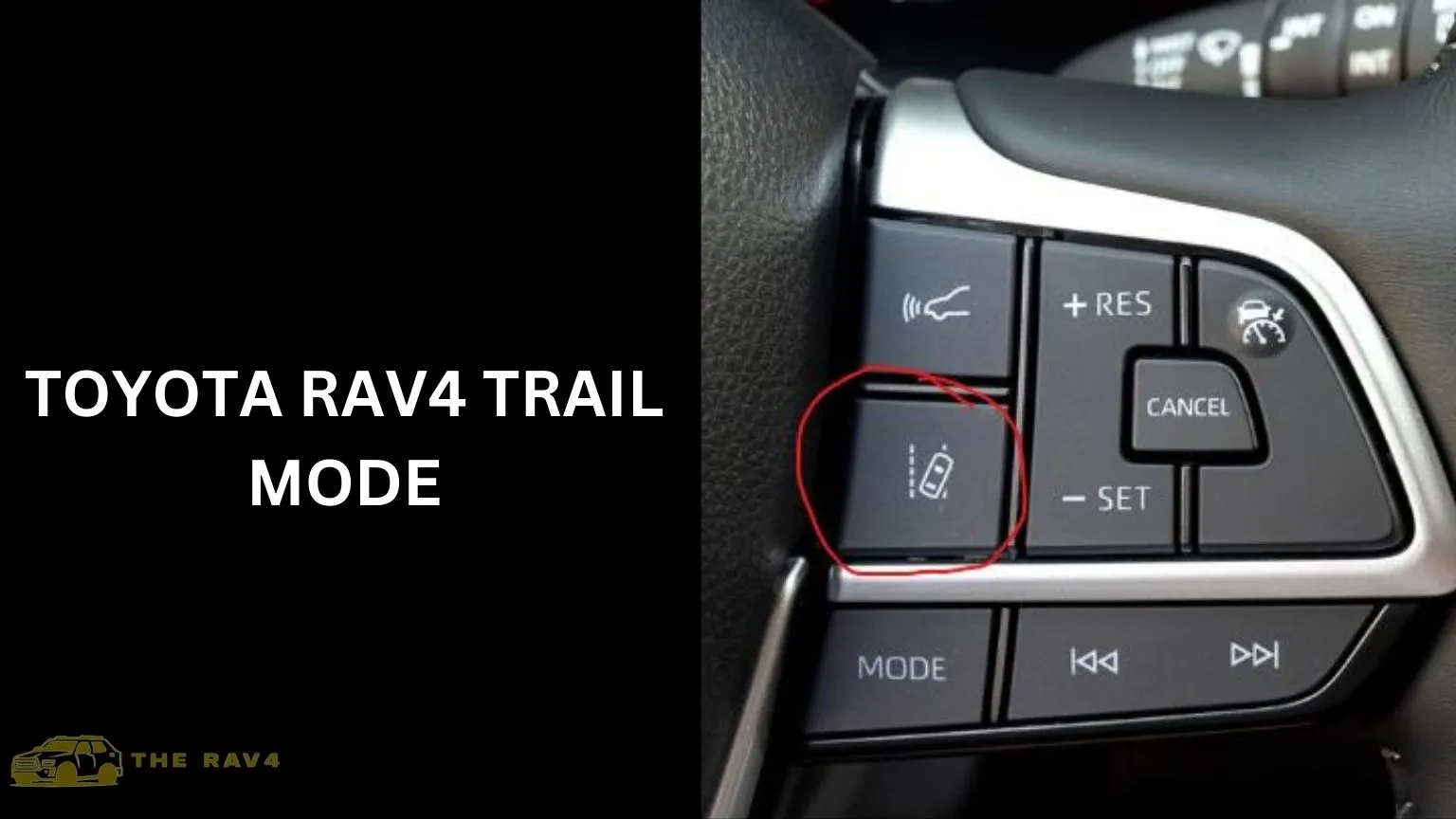
Step 1: Locate the Multi-Terrain Select Control
Location: The MTS dial or button cluster is located:
- 2019-2021 Models: Near gear shifter on center console
- 2022+ Models: On center console or integrated into touchscreen display (model dependent)
Visual Identification: Look for dial marked with terrain symbols (mud, rock, snow icons)
Step 2: Select Trail Mode
Method 1 – Rotary Dial (most models):
- Turn rotary dial to highlight “TRAIL” option
- Visual confirmation on instrument cluster
- Dial may illuminate or change color when activated
Method 2 – Touchscreen (newer models):
- Press Multi-Terrain Select button
- Touchscreen displays mode options
- Touch “TRAIL” icon
- Confirmation message appears
Method 3 – Steering Wheel Controls (some configurations):
- Use steering wheel navigation buttons
- Navigate to Multi-Terrain Select menu
- Select Trail Mode from options
Step 3: Confirm Activation
Once activated, the RAV4’s onboard systems will automatically adjust to provide optimal performance in off-road conditions.
Visual Confirmation:
- Instrument Cluster: “TRAIL” indicator illuminates (usually in green or white)
- Traction Control Icon: May show modified icon indicating Trail Mode active
- Multi-Information Display: Shows selected mode and may display traction distribution graphic
Tactile Confirmation:
- Throttle response feels different (more gradual)
- Different engine/transmission behavior noticeable
- Vehicle may feel more planted/stable
Understanding the Dashboard Display
When Trail Mode Is Active:
Primary Indicator: “TRAIL” text or icon on instrument cluster
Multi-Information Display (if equipped):
- Real-time wheel power distribution graphic
- Shows which wheels are receiving power (animated)
- Inclinometer showing vehicle pitch (front-to-back) and roll (side-to-side) angles
- Current speed
- Gear selection
Traction Control Indicator:
- Modified icon showing adjusted traction control parameters
- May show “TC OFF” or modified TC icon indicating increased slip tolerance
Deactivating Trail Mode
Method 1: Manual Selection:
- Turn dial to “AUTO” or “NORMAL” position
- Select different mode (SNOW, MUD/SAND, etc.)
- Press deactivation button (if equipped)
Method 2: Automatic Deactivation: Trail Mode may automatically deactivate when:
- Vehicle exceeds 25-30 mph for extended period
- Driver selects Sport or Eco mode
- System detects return to paved road (some models)
- Ignition is turned off and restarted (defaults to Normal)
Note: Each time you start the RAV4, it defaults to Normal mode. You must re-select Trail Mode for each drive.
Common Activation Issues and Solutions
Problem: Trail Mode Won’t Activate
Possible Causes and Solutions:
Vehicle in Park: Shift to Drive or Neutral
System Error: Warning light on dashboard requires dealer diagnosis
Speed Too High: Slow down below 25 mph
Software Glitch: Turn vehicle off, wait 30 seconds, restart
User Settings Disabled: Check vehicle settings menu to ensure MTS isn’t disabled
Problem: Trail Mode Activates But Doesn’t Seem to Work
Possible Causes:
- Tires have inadequate tread depth
- Vehicle heavily loaded beyond capability
- Terrain too challenging for vehicle limitations
- Driver expecting more dramatic difference than system provides
Solution: Understand system enhances but doesn’t create off-road capability. RAV4 still has ground clearance and approach/departure angle limitations.
Tips for Effective Trail Mode Use
Pre-Trip Preparation:
- Familiarize yourself with activation/deactivation before trail
- Practice on mild terrain before challenging conditions
- Understand which mode (Trail, Mud/Sand, Rock/Dirt) suits conditions
During Off-Road Driving:
- Activate Trail Mode before encountering difficult terrain (not during)
- Maintain steady throttle rather than sudden acceleration
- Trust the system—avoid overriding with excessive throttle
- Monitor dashboard display to understand what system is doing
After Off-Road Driving:
- Return to Normal mode when back on pavement
- Improved fuel economy and refined road manners
Trail Mode vs. Normal Driving Mode: Understanding the Differences
While the RAV4 is equally capable in normal driving conditions, Trail Mode offers distinct advantages when venturing off the beaten path.
Normal Mode Characteristics
Optimized for On-Road Performance:
In Normal mode, the vehicle prioritizes:
Fuel Efficiency:
- Rear driveshaft disconnects during highway cruising
- AWD engages only when needed
- Transmission optimizes for MPG
- Throttle response calibrated for smooth daily driving
Comfort:
- Suspension tuned for comfortable ride on pavement
- Stability control configured for road driving
- Minimal body roll in corners
- Quiet operation
Traction Control:
- Aggressive intervention at first sign of wheel slip
- Prioritizes vehicle stability over forward progress
- Ideal for rain, light snow, wet pavement
When to Use Normal Mode:
- All paved road driving (city, highway, suburban)
- Parking lots and driveways
- Light gravel roads
- Daily commuting
Fuel Economy in Normal Mode:
- EPA-rated 27 city / 35 highway / 30 combined (gas models)
- Achievable with proper driving habits
Trail Mode Characteristics
Optimized for Off-Road Conditions:
In Trail Mode, priorities shift to:
Traction:
- Maximum traction on loose, uneven surfaces
- Controlled wheel slip permitted
- Power directed to wheels with grip
- Forward progress prioritized over stability
Control:
- Precise throttle modulation
- Lower gear holding for engine braking
- Enhanced brake management
- Predictable behavior on obstacles
Capability:
- Suspension configured for uneven terrain
- Increased articulation tolerance
- Body roll accepted as necessary for maintaining tire contact
When to Use Trail Mode:
- Maintained dirt/gravel roads
- Forest service roads
- Two-track trails
- Beach sand driving
- Moderate off-road conditions
Fuel Economy in Trail Mode:
- Reduced compared to Normal mode (expect 18-25 mpg depending on terrain)
- AWD system constantly active (increased drag)
- Lower gears and increased engine load
Side-by-Side Comparison
| Aspect | Normal Mode | Trail Mode |
|---|---|---|
| Primary Purpose | On-road driving | Off-road conditions |
| Fuel Economy | Optimized (30 mpg) | Reduced (18-25 mpg) |
| Traction Control | Aggressive intervention | Allows controlled slip |
| Throttle Response | Normal road calibration | Gradual off-road tuning |
| AWD Engagement | As needed | Continuous |
| Gear Selection | Optimized for efficiency | Lower gears held longer |
| Ride Comfort | Maximum | Secondary to capability |
| Best Speeds | All speeds | Under 25 mph optimal |
Can You Switch Between Modes While Driving?
Yes, you can switch between Normal and Trail Mode while driving:
Safe to Switch:
- At any speed (though benefits diminish above 25 mph)
- On any surface
- As conditions change
Best Practice:
- Switch to Trail Mode before encountering challenging terrain
- Avoid switching mid-obstacle (may confuse system momentarily)
- Return to Normal when back on pavement
System Response:
- Transition takes 1-2 seconds
- No jarring changes in vehicle behavior
- Smooth engagement/disengagement
The “Wrong Mode” Scenario
What Happens If You Use Trail Mode on Pavement?
Effects:
- Reduced fuel economy (5-10% penalty)
- Slightly less refined throttle response
- No harm to vehicle
- Unnecessary wear on AWD components
What Happens If You Use Normal Mode Off-Road?
Effects:
- Less optimal traction (may get stuck where Trail Mode wouldn’t)
- More aggressive traction control intervention
- Reduced confidence and capability
- Possible wheel spin without forward progress
- No damage to vehicle, just reduced capability
Verdict: Using Trail Mode on pavement is wasteful but harmless. Using Normal mode off-road reduces capability but doesn’t cause damage.
Off-Road Performance Enhancements with Trail Mode
Trail Mode’s performance enhancements extend beyond traction and stability, encompassing multiple vehicle systems working in harmony.
Throttle Response and Hill Climbing
How Trail Mode Adjusts Throttle:
Progressive Power Delivery: It also adjusts the vehicle’s throttle response, allowing for precise control when navigating tricky terrain.
Linear Response Curve:
- First 50% of pedal travel provides smooth, gradual power increase
- Prevents abrupt wheel spin on loose surfaces
- Allows fine control at low speeds
Prevents Wheel Hop:
- Smooth power delivery eliminates harsh acceleration that causes wheels to hop
- Maintains tire contact with ground
- Better traction and vehicle control
Hill Climbing Benefits:
Momentum Maintenance:
- Steady power delivery maintains momentum up steep grades
- Prevents momentum loss from excessive wheelspin
- Optimal power distribution to wheels with traction
Engine Braking on Descents:
- Lower gear holding provides natural engine braking
- Reduces brake usage on long descents
- Prevents brake overheating
Rocky Obstacle Climbing:
- Precise throttle control allows inch-by-inch rock crawling
- Driver can modulate power exactly as needed
- Prevents tire spinning on rock surfaces
Braking System Optimization
Furthermore, Trail Mode optimizes the braking system for off-road conditions, reducing the risk of skidding and ensuring a safe driving experience.
Brake Lock Differential (BLD):
How It Works:
- Detects which wheel is slipping
- Applies brake to slipping wheel
- Forces torque transfer to wheel with traction
- Creates “virtual limited-slip differential” effect
Advantages Over Mechanical Limited-Slip:
- Works on all four wheels independently
- No maintenance required
- Lighter weight
- Adjusts instantly to changing conditions
ABS Calibration for Loose Surfaces:
Modified Thresholds:
- ABS intervention occurs at different wheel speed differentials
- Allows more wheel lockup on loose surfaces (where it’s beneficial)
- Prevents premature ABS activation that would reduce stopping power
Result: Better stopping control on dirt, gravel, and sand
Downhill Performance:
Hill Descent Control (HDC) Integration:
- Works seamlessly with Trail Mode
- Maintains constant speed (adjustable 2-12 mph) on descents
- Automatically modulates all four brakes independently
- Driver focuses on steering only
When HDC + Trail Mode Combined:
- Ultimate control on steep descents
- System prevents wheel lockup while maintaining speed control
- Can navigate 25-degree+ slopes safely
Suspension and Handling Characteristics
Dynamic Handling:
While RAV4 doesn’t have adjustable suspension height or stiffness, Trail Mode affects handling:
Stability Control Parameters:
- Higher intervention thresholds allow more body roll
- System tolerates greater wheel speed differences
- Permits controlled slides rather than aggressive correction
Weight Transfer Management:
- System manages weight transfer during acceleration and braking
- Optimizes tire contact patch during articulation
- Maintains stability while allowing necessary body motion
Result: More natural off-road handling that works with terrain rather than fighting it
Traction Visualization and Feedback
Multi-Information Display Graphics:
Real-Time Traction Display:
- Shows power distribution to all four wheels
- Animated display updates in real-time
- Driver can see system working
Benefits:
- Educational: Helps drivers understand what system is doing
- Confidence Building: Visual confirmation system is helping
- Situational Awareness: Shows which wheels have traction
Inclinometer Display:
- Shows vehicle pitch (front-to-back angle)
- Shows vehicle roll (side-to-side angle)
- Helps driver assess whether slope is safe to traverse
Practical Application: Knowing you’re on a 15-degree slope helps you decide whether to continue or turn back.
Steering Feel and Response
Trail Mode Steering Adjustments:
Increased Feedback:
- Less power steering assistance at low speeds
- More road feel through steering wheel
- Helps driver sense wheel traction
Center Feel:
- Firmer on-center steering
- Reduces need for constant corrections
- More confidence-inspiring on uneven surfaces
Variable Assist:
- Changes based on speed and terrain
- Light enough for maneuverability
- Heavy enough for control and feedback
Safety Features in Trail Mode
Safety is paramount, even in off-road settings. Toyota has equipped the RAV4 Trail Mode with advanced safety features to protect occupants and vehicle.
Hill Descent Control (HDC)
What It Does:
Hill Descent Control regulates the vehicle’s speed when descending steep slopes, maintaining a constant, controllable speed without driver brake input.
Activation:
- Press HDC button on dashboard or center console
- Set desired descent speed (2-12 mph typically)
- System automatically modulates brakes
How It Works:
- Monitors vehicle speed and wheel speed sensors
- Applies individual wheel brakes as needed
- Maintains set speed regardless of slope steepness
- Works in forward or reverse
When to Use HDC:
- Descending steep grades (over 10-15 degrees)
- Loose or slippery downhill surfaces
- Long descents where brake overheating is concern
- Situations requiring precise speed control
Benefits:
- Driver focuses 100% on steering
- Prevents runaway descent
- Eliminates brake overheating risk
- Provides smooth, controlled descent
- Reduces driver stress and fatigue
HDC + Trail Mode Synergy: When both are active:
- Trail Mode optimizes traction during descent
- HDC manages speed
- Result is ultimate control on steep off-road descents
Multi-Terrain Monitor (Select Models)
360-Degree Camera Views:
Available Views:
- Front View: See obstacles directly ahead
- Side Views: Check wheel position relative to rocks, ruts
- Rear View: Monitor trailer or what’s behind
- Overhead View: Bird’s-eye perspective of vehicle position
Off-Road Camera Benefits:
- Spot obstacles hidden by hood
- Position wheels precisely on trails
- Avoid scraping undercarriage on rocks
- Navigate between trees or narrow passages
Terrain View Modes:
- Wide-angle view for general navigation
- Close-up view for precise obstacle negotiation
- Split screen showing multiple angles simultaneously
Continuous Terrain Monitoring
Additionally, the Trail Mode system continuously monitors road conditions and adjusts settings to prevent accidents and ensure driver confidence.
Active Monitoring Systems:
Wheel Speed Sensors:
- Monitor each wheel’s rotation speed
- Detect slippage instantly
- Feed data to traction control system
Steering Angle Sensor:
- Monitors steering input direction and rate
- Helps predict vehicle trajectory
- Allows system to anticipate needed interventions
Yaw Rate Sensor:
- Detects vehicle rotation rate
- Identifies potential skids or slides
- Enables proactive stability control
G-Force Sensors:
- Monitor lateral and longitudinal acceleration
- Detect loss of traction
- Help system respond to dynamic conditions
Throttle Position Sensor:
- Tracks driver throttle input
- Allows system to anticipate power needs
- Coordinates with other systems
Real-Time Adjustment:
The system makes adjustments dozens of times per second:
- Traction control intervention levels
- Power distribution front-to-rear and left-to-right
- Brake pressure to individual wheels
- Throttle response curves
- Transmission gear selection
Result: Seamless, transparent operation that enhances capability without requiring driver intervention or expertise.
Roll Stability Control
Preventing Rollovers:
While RAV4s have low rollover risk due to design, Trail Mode includes enhanced stability control:
How It Works:
- Monitors vehicle roll angle
- Detects if vehicle is approaching rollover threshold
- Reduces engine power
- Applies selective braking to prevent rollover
Off-Road Application:
- Allows normal off-road body roll
- Intervenes only at dangerous angles
- Permits 20-25 degree side slopes safely
- Warns driver if approaching limits
Emergency Brake Assist Integration
Trail Mode + Safety Sense:
Trail Mode works with Toyota Safety Sense 2.0/2.5+ features:
Obstacle Detection:
- Forward collision warning remains active
- Pre-Collision System monitors for obstacles
- Can alert to obstacles obscured by terrain
Automatic Emergency Braking:
- Remains functional in Trail Mode
- Can prevent collision if driver doesn’t respond
- Calibrated for off-road speeds
Note: Some drivers disable pre-collision features off-road to prevent false activation from brush, but system generally performs well.
Underbody Protection
Trail Mode Doesn’t Add Physical Protection, but Adventure and TRD Off-Road models include:
Skid Plates:
- Engine skid plate (protects oil pan, front suspension)
- Fuel tank skid plate (protects tank from rock strikes)
- Transfer case protection (AWD components)
Enhanced Undercoating:
- Thick protective coating on underbody
- Prevents rust from trail debris
- Reduces noise from rock impacts
These Work With Trail Mode: Electronic capability paired with physical protection provides comprehensive off-road confidence.
Tips for Using Trail Mode Safely and Effectively
While Trail Mode enhances off-road capabilities, it’s essential to use it responsibly. Here are comprehensive tips for safely using Trail Mode in the Toyota RAV4.
1. Familiarize Yourself Before Off-Roading
Pre-Trail Preparation:
Familiarize yourself with the Trail Mode settings and functionalities before venturing off-road.
Read the Owner’s Manual:
- Understand system limitations
- Learn activation procedures
- Review safety warnings
- Know dashboard indicators
Practice in Safe Environment:
- Empty parking lot
- Mild dirt road
- Low-risk area where you can experiment
- Practice mode changes
Understand Your RAV4’s Limitations:
- Ground Clearance: 8.4-8.6 inches (Adventure/TRD Off-Road)
- Approach Angle: 18-19 degrees
- Departure Angle: 23-24 degrees
- Water Fording: 20 inches maximum (check owner’s manual)
- Maximum Off-Road Angle: 25-degree side slopes
2. Choose Appropriate Terrain
Know What RAV4 Can and Cannot Handle:
Suitable Terrain:
- Maintained gravel roads
- Forest service roads (dry)
- Fire roads
- Beach driving (firm sand)
- Two-track trails (mild)
- Light rock gardens
- Moderate mud (not deep)
Unsuitable Terrain:
- Extreme rock crawling
- Deep water crossings (over 20 inches)
- Extreme approach/departure angles (over 25 degrees)
- Very deep mud
- Severe articulation requirements
- Technical 4×4-only trails
Assessment Before Proceeding:
- Walk the trail first if uncertain
- Check depth of obstacles
- Look for alternate paths
- Have backup plan if trail worsens
3. Maintain Appropriate Speed
Always adhere to recommended speed limits and driving techniques for off-road conditions.
Trail Mode Speed Guidelines:
Technical Sections: 2-5 mph
- Rock gardens, obstacles, steep grades
Moderate Trails: 5-15 mph
- Gravel roads, mild ruts, forest roads
Easy Trails: 15-25 mph maximum
- Well-maintained dirt roads, flat gravel
Never Exceed: 25 mph in Trail Mode
- System optimized for low speeds
- Benefits diminish above 25 mph
- Safety risk increases dramatically
Why Slow Is Better:
- More time to react to obstacles
- Less risk of undercarriage damage
- Better traction and control
- Reduced bounce and body roll
The “Slow is Pro” Mindset: Experienced off-roaders drive slowly. Speed doesn’t demonstrate skill—control does.
4. Use Correct Mode for Conditions
Mode Selection Guide:
Trail Mode: General off-roading, mixed conditions, default choice
Mud & Sand Mode: Deep mud, soft sand, situations requiring momentum
Rock & Dirt Mode: Technical rock crawling, hard-packed trails, precise control needed
Snow Mode: Snow, ice, extremely slippery conditions
When to Switch Modes Mid-Trail:
- Enter significantly different terrain
- Notice reduced traction in current mode
- Mode seems to be working against you
5. Maintain Your RAV4 Properly
Regularly inspect and maintain your RAV4 to ensure optimal performance of Trail Mode and other systems.
Critical Maintenance for Off-Road Use:
Tires:
- Check pressure weekly (lower for sand, normal for most trails)
- Inspect for cuts, punctures after each trip
- Rotate every 5,000 miles
- Replace when tread depth below 4/32″
- Consider all-terrain tires for serious off-roading
Fluids:
- Check differential fluid every 30,000 miles
- Change transmission fluid every 60,000 miles
- Monitor coolant level closely
- Check oil before and after off-road trips
Undercarriage:
- Wash undercarriage after muddy trips
- Inspect skid plates for damage
- Check suspension components for leaks or damage
- Look for loose bolts or fasteners
Brakes:
- Inspect brake pads (off-roading accelerates wear)
- Check brake fluid level and condition
- Clean brake dust from wheels after dusty trails
AWD System:
- Listen for unusual noises from drivetrain
- Report any vibrations to dealer
- Follow severe service schedule (30,000-mile differential fluid changes)
6. Travel with Proper Equipment
Essential Off-Road Kit:
Recovery Gear:
- Tow strap or recovery rope (rated 10,000+ lbs)
- D-ring shackles
- Shovel (for digging out)
- Traction boards (MaxTrax or similar)
- Work gloves
Emergency Supplies:
- First aid kit (comprehensive)
- Fire extinguisher
- Emergency blanket
- Flashlight and extra batteries
- Multi-tool or knife
Communication:
- Fully charged phone
- Portable battery pack
- CB radio or HAM radio (if in remote areas)
- Whistle (for signaling)
Vehicle Supplies:
- Full-size spare tire (properly inflated)
- Jack and lug wrench
- Tire repair kit
- Fix-a-flat (temporary solution)
- Basic tool set
- Duct tape, zip ties
- Extra fluids (oil, coolant)
Comfort/Survival:
- Water (1 gallon per person)
- Food/snacks
- Weather-appropriate clothing
- Map and compass (don’t rely solely on GPS)
7. Never Off-Road Alone
Buddy System Benefits:
Safety:
- Help if vehicle gets stuck
- Assistance in emergency
- Someone to walk ahead and spot obstacles
- Two vehicles can winch each other
Recovery:
- Tow strap recovery requires two vehicles
- Significantly easier extraction with help
- Reduced risk of injury
Communication:
- Can communicate trail conditions
- One vehicle can go for help if needed
Best Practices:
- Minimum two vehicles
- Travel in sight of each other
- Agree on hand signals
- Share trail plans
8. Know Your Exit Strategy
Before Proceeding:
Can You Turn Around?:
- Is trail wide enough?
- Can you back out if needed?
- Is there a turnaround spot ahead?
Point of No Return:
- Recognize when trail commits you forward
- Make decision before this point
- When in doubt, turn back
Communication:
- Tell someone where you’re going
- Expected return time
- Emergency contact plan
9. Respect the Environment
Tread Lightly Principles:
Stay on Designated Trails:
- Don’t create new trails
- Avoid widening existing trails
- Respect closures and restrictions
Pack Out What You Pack In:
- Leave no trace
- Dispose of trash properly
- Don’t disturb wildlife or plants
Minimize Impact:
- Avoid unnecessary wheel spin
- Don’t drive through streams (use crossing points)
- Respect other users (hikers, bikers, horseback riders)
10. Take an Off-Road Driving Course
Consider taking off-road driving courses or seeking guidance from experienced off-road enthusiasts for a safer and more enjoyable experience.
What You’ll Learn:
- Proper line selection
- Obstacle negotiation
- Recovery techniques
- Vehicle limitations
- Trail etiquette
Where to Find Courses:
- Off-road driving schools
- 4×4 clubs and organizations
- Toyota dealership events (some dealers offer)
- State and national parks
Benefits:
- Increased confidence
- Better vehicle control
- Understanding of capabilities
- Safer off-road experience
- Meet other enthusiasts
Common Trail Mode Questions and Misconceptions
Misconception: Trail Mode Makes RAV4 a “Real” Off-Roader
Reality: Trail Mode significantly enhances capability but doesn’t transform the RAV4 into a Jeep Wrangler or Toyota 4Runner.
What Trail Mode Does:
- Optimizes existing systems for off-road use
- Maximizes capability within design parameters
- Provides confidence on moderate trails
What Trail Mode Doesn’t Do:
- Add ground clearance (fixed by suspension design)
- Install locking differentials (uses brake-based system)
- Change approach/departure angles (fixed by body design)
- Provide low-range gearing (RAV4 doesn’t have transfer case)
Verdict: Trail Mode makes the RAV4 very capable for its class, but it’s still a car-based crossover, not a body-on-frame SUV.
Misconception: You Should Use Trail Mode All the Time
Reality: Trail Mode is purpose-built for off-road conditions and should only be used in those situations.
Why Not Use Constantly:
- Reduced fuel economy (5-10% penalty)
- Unnecessary AWD engagement
- Increased component wear
- Less refined on-road behavior
Use Trail Mode Only:
- When actually driving off pavement
- On surfaces requiring enhanced traction
- In conditions where Normal mode struggles
Misconception: Trail Mode Prevents All Wheel Spin
Reality: Trail Mode allows controlled wheel spin—this is intentional and necessary for off-road traction.
Why Controlled Spin Matters:
- Digging through soft surfaces
- Maintaining momentum
- Finding traction beneath loose material
- Clearing tire treads
The System:
- Monitors and manages wheel slip
- Allows productive spin
- Prevents excessive, non-productive spin
Question: Does Trail Mode Work in Reverse?
Yes: Trail Mode functions in both forward and reverse gears.
Reverse Applications:
- Backing down steep grades
- Extracting from stuck positions
- Navigating obstacles in reverse
Same Benefits:
- Traction optimization
- Controlled power delivery
- Brake management
Real-World Performance: Owner Experiences and Reviews
Many RAV4 owners have shared their positive experiences with Trail Mode, praising its performance, reliability, and ease of use.
Professional Reviews
Motor Trend (2019 RAV4 Adventure Review): “The Multi-Terrain Select system with Trail Mode transforms the RAV4 from a competent crossover into a surprisingly capable trail vehicle. While it won’t conquer Rubicon, it handled our moderate trail loop with confidence.”
Car and Driver (2020 TRD Off-Road Test): “Trail Mode’s ability to meter power and modulate braking makes the RAV4 TRD Off-Road far more capable than its crossover platform suggests. We navigated rocky, rutted forest roads that would intimidate many vehicle owners.”
Off-Road.com (2021 Adventure Long-Term): “Six months and 15,000 miles of mixed use—including desert trails, forest roads, and beach driving—proves Trail Mode isn’t just a gimmick. It genuinely enhances capability and driver confidence.”
Owner Testimonials
Case Study 1: Pacific Northwest Trail Driving
Owner: Mike T., Washington Vehicle: 2020 RAV4 Adventure
Experience: “I use my RAV4 to access trailheads and camping spots throughout the Cascades. Trail Mode has proven invaluable on muddy forest service roads, especially during shoulder seasons. The system’s ability to manage wheel slip while maintaining forward progress has gotten me through sections where I expected to get stuck. I’ve been genuinely impressed.”
Most Memorable Moment: “Last fall, navigated a steep, muddy downhill with Trail Mode and Hill Descent Control. The system handled it perfectly—smooth, controlled descent with zero drama. I barely touched the brake pedal.”
Case Study 2: Beach Driving
Owner: Sandra K., North Carolina Vehicle: 2019 RAV4 Limited
Experience: “We regularly drive on the Outer Banks beaches to reach fishing spots. Trail Mode’s Mud & Sand setting makes a huge difference. Before discovering this feature, we struggled in soft sand. Now we confidently navigate loose beach conditions that used to worry us.”
Key Insight: “Proper tire pressure (down to 20 PSI) combined with Trail Mode in Mud/Sand setting = confident beach driving.”
Case Study 3: Snow Country
Owner: David R., Colorado Vehicle: 2021 RAV4 TRD Off-Road
Experience: “Colorado mountain living means snow and ice are reality for months. While I use Snow mode on icy roads, Trail Mode has proven excellent for accessing our mountain property on unplowed roads. The combination of ground clearance, Trail Mode traction management, and decent tires makes the RAV4 surprisingly capable in deep snow.”
Comparison: “Previously owned a Subaru Outback. RAV4 with Trail Mode is noticeably better in mixed snow and mud conditions common on our access road.”
Case Study 4: Overlanding Adventures
Owner: Jessica and Tom H., Arizona Vehicle: 2020 RAV4 Adventure
Experience: “We’ve taken our RAV4 on several overlanding trips throughout the Southwest. Trail Mode has handled everything from sand washes to rocky desert trails. While we know the vehicle’s limits and don’t attempt extreme terrain, we’ve been pleasantly surprised by what the RAV4 can navigate.”
Memorable Trip: “Four-day trip through Arizona Backcountry Discovery Route. Trail Mode handled varied terrain confidently—sandy washes, rocky climbs, and rutted two-tracks. Vehicle never felt out of its depth.”
Common Owner Observations
Users appreciate the seamless transition between normal driving and Trail Mode, as well as the enhanced confidence it provides when tackling challenging terrain.
Positive Feedback Themes:
Ease of Use: “Simple activation, no complex procedures” Real-World Effectiveness: “Actually makes a noticeable difference” Confidence Building: “Feel more capable tackling trails” Versatility: “Handles mix of conditions well” Daily Driving Unaffected: “No penalty when not using Trail Mode”
Constructive Criticism:
Dashboard Display: “Would like more detailed real-time information about what system is doing” Mode Memory: “Wish it remembered last-used mode rather than defaulting to Normal” Speed Limitation: “Benefits disappear above 25 mph” Not Magic: “Still limited by ground clearance and approach angles”
Overall, Trail Mode has garnered widespread acclaim for its ability to elevate off-road adventures in the Toyota RAV4, with most owners feeling it significantly enhances the vehicle’s capability and their confidence in challenging conditions.
Trail Mode vs. Competitors: How Does RAV4 Stack Up?
Understanding how RAV4 Trail Mode compares to similar systems in competitor vehicles helps contextualize its capability.
Honda CR-V – Intelligent Terrain Management
System: Intelligent Terrain Management (available on AWD models)
Modes: Snow, Mud, Sand
How It Compares:
Similarities:
- Electronic traction optimization
- Multiple mode selection
- Works with existing AWD
Differences:
- No dedicated “Trail” mode
- Less sophisticated than RAV4’s system
- Simpler interface
Verdict: RAV4’s Trail Mode more comprehensive and capable
Subaru Forester – X-Mode
System: X-MODE (standard on most trims)
Modes: Snow/Dirt, Deep Snow/Mud (two-mode system on higher trims)
How It Compares:
Advantages of X-MODE:
- Highly effective system
- Proven Subaru AWD reputation
- Standard on more trims
Advantages of RAV4 Trail Mode:
- More mode options (four vs. two)
- Better dashboard visualization
- Integrated with superior ground clearance (RAV4 Adventure/TRD)
Verdict: Both excellent systems; Subaru’s AWD reputation strong, but RAV4 offers more capability in Adventure/TRD trims
Mazda CX-5 – Off-Road Traction Assist
System: Off-Road Traction Assist (available AWD models)
Modes: Single off-road mode
How It Compares:
Mazda System:
- Simpler single-mode approach
- Less comprehensive than RAV4
- CX-5 more road-focused overall
RAV4 Advantage:
- Multiple specialized modes
- Better ground clearance
- Purpose-built off-road capability
Verdict: RAV4 significantly more capable off-road
Nissan Rogue – Intelligent 4×4
System: Intelligent 4×4 with Terrain Mode Select
Modes: Standard, Sport, Eco, Snow, Off-Road
How It Compares:
Similarities:
- Multiple mode selection
- Electronic traction management
RAV4 Advantages:
- More specialized modes (Mud/Sand, Rock/Dirt vs. generic Off-Road)
- Better ground clearance options
- Stronger off-road reputation
Verdict: RAV4 more capable, especially Adventure/TRD variants
Jeep Cherokee – Selec-Terrain
System: Selec-Terrain (various versions by trim)
Modes: Auto, Snow, Sport, Sand/Mud, Rock (Trailhawk)
How It Compares:
Jeep Advantages:
- Legendary off-road brand
- Trailhawk offers exceptional capability
- Available disconnecting sway bar
- Better approach/departure angles
RAV4 Advantages:
- Superior reliability reputation
- Better fuel economy
- Lower maintenance costs
- More refined on-road
Verdict: Jeep Trailhawk more capable off-road; RAV4 better all-around vehicle for most owners
Ford Escape – Terrain Management System
System: Terrain Management System (available)
Modes: Normal, Eco, Sport, Slippery, Deep Conditions
How It Compares:
Systems Similar:
- Multiple mode selection
- Electronic management
RAV4 Advantages:
- Better reliability track record
- More intuitive interface
- Stronger resale value
- Better ground clearance (Adventure/TRD)
Verdict: RAV4 offers better overall package
Summary: RAV4’s Position in Segment
RAV4 Trail Mode positions the vehicle as:
Most Capable Mainstream Crossover: Better than Honda, Nissan, Mazda Competitive with Subaru: Both excellent; personal preference Less Capable than Jeep Trailhawk: But better daily driver and more reliable Best Balance: Capability + reliability + refinement + value
For buyers seeking genuine off-road capability without sacrificing daily drivability, RAV4 Adventure/TRD Off-Road with Trail Mode is the sweet spot.
Maintenance Considerations for Trail Mode Use
Proper maintenance is crucial to preserving Trail Mode’s functionality and ensuring long-term reliability.
Regular Maintenance Schedule
Toyota recommends following the manufacturer’s maintenance schedule and conducting regular inspections of critical components such as the suspension, drivetrain, and electronic systems.
Standard Maintenance (All RAV4s):
- Oil changes: Every 10,000 miles (or 5,000 if severe service)
- Tire rotation: Every 5,000 miles
- Brake inspection: Every 10,000 miles
- Battery test: Annually
- Coolant replacement: 100,000 miles
Additional Off-Road Maintenance (Adventure/TRD Off-Road):
More Frequent Services:
Differential Fluid (AWD system):
- Normal: Change at 60,000 miles
- Off-Road Use: Change at 30,000 miles
- Cost: $150-$250
- Critical for AWD longevity
Transmission Fluid:
- Normal: Change at 60,000 miles
- Off-Road Use: Change at 45,000 miles
- Cost: $200-$350
- Protects transmission from stress
Brake System:
- Off-roading accelerates brake wear
- Inspect every 5,000 miles if frequently off-road
- Flush brake fluid every 30,000 miles (vs. 45,000)
Suspension Components:
- Inspect struts, shocks, bushings every 10,000 miles
- Off-road use accelerates wear
- Replace worn components promptly
Post-Off-Road Inspection
After Every Off-Road Trip:
Immediate Checks (Before Next Drive):
Undercarriage Inspection:
- Look for damage to skid plates
- Check for leaking fluids
- Inspect exhaust system
- Look for loose components
Tires:
- Check for cuts, punctures, embedded objects
- Inspect sidewalls for damage
- Reset tire pressure to normal
- Remove rocks from tread
Wheel Wells:
- Remove packed mud or debris
- Check for damage to fender liners
- Ensure nothing interferes with steering
Cleaning (Within 24-48 Hours):
Undercarriage Wash:
- Spray off mud and debris
- Pay attention to suspension components
- Clean brake components
- Remove vegetation from underside
Wheels and Tires:
- Remove mud from wheels
- Clean brake dust
- Check for unusual wear patterns
Body:
- Wash to prevent scratches from dirt
- Clean headlights and taillights
- Check for new scratches or dents
AWD System Care
Maintaining Dynamic Torque Vectoring AWD:
Listen for Unusual Noises:
- Grinding from rear differential
- Clicking from CV joints
- Whining from transfer components
Watch for Warning Signs:
- AWD warning light
- Unusual vibrations at certain speeds
- Pulling to one side
Fluid Service:
- Use only Toyota-approved differential fluid
- Never use additives without Toyota approval
- Have service performed at dealer or qualified shop
Tire Considerations for Off-Road Use
Factory Tires:
- RAV4 Adventure: Falken Wildpeak A/T Trail
- RAV4 TRD Off-Road: Falken Wildpeak A/T Trail
- Limited: Bridgestone Dueler H/L (highway tires)
Upgrade Considerations:
All-Terrain Tires:
- Better off-road traction
- More aggressive tread
- Louder on pavement
- Slight fuel economy penalty
Popular Options:
- BFGoodrich All-Terrain T/A KO2
- Goodyear Wrangler Duratrac
- General Grabber AT/X
- Yokohama Geolandar A/T G015
Tire Maintenance:
- Check pressure before each trail (lower for sand)
- Rotate every 5,000 miles religiously
- Replace when tread below 4/32″
- Inspect for irregular wear
Warranty Considerations
What’s Covered:
Trail Mode System:
- Covered under 3-year/36,000-mile basic warranty
- Electronic components covered
- Software issues addressed free
What’s NOT Covered:
Off-Road Damage:
- Undercarriage damage from rocks
- Bent suspension components
- Damaged skid plates
- Punctured oil pan or fuel tank
Modifications:
- Lift kits void suspension warranty
- Oversized tires void drivetrain warranty
- Non-Toyota parts may void related warranties
Best Practice: Keep vehicle stock, maintain meticulously, and document all maintenance for warranty protection.
Future Developments in Trail Mode Technology
As technology evolves, Toyota continues to innovate and improve Trail Mode functionality.
Rumored and Expected Improvements
Enhanced Terrain Recognition:
Automatic Mode Selection:
- System automatically selects optimal mode based on terrain sensors
- Camera-based terrain identification
- Eliminates need for manual mode selection
Predictive Traction Control:
- Forward-looking cameras identify obstacles ahead
- System pre-adjusts parameters before reaching obstacle
- Smoother, more seamless operation
Integration with Autonomous Features
Semi-Autonomous Off-Roading:
Obstacle Detection and Navigation:
- Advanced cameras map terrain ahead
- System suggests optimal line through obstacles
- Can autonomously navigate simple obstacles
Automatic Trail Following:
- Vehicle follows GPS trail coordinates
- Driver steers, system manages speed and traction
- Similar to highway cruise control for trails
Important Note: These features remain speculative and prioritize safety and driver engagement over full autonomy.
Enhanced Customization
Programmable Modes:
Custom Trail Profiles:
- Drivers create custom modes for specific trails
- Save preferred settings (throttle response, traction limits)
- Recall settings for favorite off-road locations
Shared Trail Data:
- Upload trail conditions to cloud
- Access other drivers’ trail data
- Community-sourced difficulty ratings and tips
Advanced Suspension Integration
Adaptive Damping:
Electronic Suspension Control:
- Real-time damping adjustment based on terrain
- Firmer for rock crawling, softer for washboard roads
- Improves ride quality and tire contact
Note: Current RAV4 has conventional suspension; future versions might incorporate adaptive systems.
Improved Driver Feedback
Augmented Reality Display:
Heads-Up Display Integration:
- Trail information projected on windshield
- Obstacle warnings and approach angle indicators
- Real-time traction visualization
Enhanced Multi-Information Display:
- Detailed traction data for each wheel
- Live video of underbody cameras
- 3D terrain mapping
Electric and Hybrid Integration
RAV4 Prime Trail Mode:
Currently, RAV4 Prime (PHEV) doesn’t offer Trail Mode, but future integration could provide:
Electric Torque Vectoring:
- Individual electric motors at each wheel
- Instant, precise power delivery
- Superior off-road control
Combined Power:
- Electric + gas = exceptional torque
- Better low-speed control
- Improved fuel economy even off-road
Connectivity Features
Trail Mode App Integration:
Smartphone Connection:
- Monitor vehicle systems from phone
- Pre-configure settings before entering vehicle
- Track off-road statistics and adventures
Trail Sharing:
- Share favorite trails with friends
- Access community trail database
- Real-time trail condition updates
These advancements aim to further enhance off-road performance and redefine the driving experience for RAV4 owners, though Toyota typically introduces new features conservatively, prioritizing reliability and proven technology over cutting-edge features.
Frequently Asked Questions
What is the RAV4 Trail package?
The RAV4 doesn’t have a separate “Trail Package.” Instead, Trail Mode is a feature included standard on specific trims:
- RAV4 Adventure (AWD)
- RAV4 TRD Off-Road
- RAV4 Limited (AWD)
These trims come with the Multi-Terrain Select system, which includes Trail Mode along with Mud & Sand, Rock & Dirt, and Snow modes.
What Adventure and TRD Off-Road trims include:
- Increased ground clearance (8.6 inches vs. 8.4 inches)
- Dynamic Torque Vectoring AWD (sends power to individual rear wheels)
- Enhanced suspension tuned for off-road use
- All-weather floor mats
- Distinctive exterior styling with unique wheels, aggressive body cladding, and special badging
TRD Off-Road adds:
- Falken Wildpeak all-terrain tires
- TRD-tuned suspension
- Unique TRD wheels and styling
- Red TRD badging throughout
If you want Trail Mode, you must purchase one of these specific trims—it cannot be added as a standalone option to base LE or XLE models.
When buying: Verify the vehicle has AWD (all models with Trail Mode are AWD) and confirm Multi-Terrain Select is present by looking for the mode selector dial or buttons near the gear shifter.
What are the modes of the RAV4?
The Toyota RAV4 offers several driving modes depending on the trim level and model year.
Standard Driving Modes (All RAV4s):
- Normal — Default balanced driving
- Eco — Maximizes fuel efficiency with gentler throttle response and optimized climate control
- Sport — Enhances throttle response and steering feel for more engaging driving
Electric Vehicle Modes (RAV4 Hybrid and Prime Only):
- EV mode — Allows electric-only driving when battery has sufficient charge (Hybrid: up to 1 mile, Prime: up to 42 miles)
Multi-Terrain Select Modes (Adventure, TRD Off-Road, Limited AWD Only):
- Trail Mode — Balanced off-road optimization for mixed terrain
- Mud & Sand Mode — Maximum wheel slip tolerance for soft surfaces
- Rock & Dirt Mode — Precise control for technical terrain
- Snow Mode — Minimal slip tolerance for winter conditions
Important: Not all RAV4s have all modes. Base LE and mid-level XLE/XLE Premium have only Normal, Eco, and Sport. To get the off-road Multi-Terrain Select modes including Trail Mode, you must purchase Adventure, TRD Off-Road, or Limited AWD trims.
The mode selector is typically located near the gear shifter (rotary dial or button cluster) for Multi-Terrain Select, while Eco and Sport are accessed via steering wheel buttons or touchscreen on most models.
Should I drive my RAV4 in Sport mode?
Driving your RAV4 in Sport mode can provide a more engaging driving experience through:
- Enhanced throttle response (more immediate acceleration from throttle inputs)
- Sharper steering feel (reduced power steering assist, more road feedback)
- Altered transmission behavior (holds gears longer, delays upshifts for better acceleration)
The downsides:
- Increased fuel consumption (typically 2-5 mpg reduction)
- Firmer ride quality (on models with adaptive suspension)
- More engine noise (higher RPMs before shifting)
When to use Sport mode:
- Merging onto highways (extra responsiveness helpful)
- Mountainous driving (better engine braking and power control)
- Spirited driving when you want more engagement
- Passing maneuvers (quicker throttle response)
When NOT to use Sport mode:
- Daily commuting (wastes fuel unnecessarily)
- City stop-and-go traffic (aggressive throttle response can be annoying)
- Trying to maximize fuel economy
- Highway cruising (no benefit at steady speeds)
Best practice: Use Normal mode for everyday driving to maximize fuel efficiency and comfort. Switch to Sport mode when you want more engaging driving or need extra responsiveness, and return to Normal afterward.
Sport mode doesn’t harm the vehicle—it’s safe to use anytime—but using it constantly reduces fuel economy by 5-15% with no real benefit in normal driving.
What is the TRAC button on the Toyota RAV4?
The “TRAC” button stands for Traction Control. When pressed and held for 3 seconds, it disables or reduces the traction control system, which normally helps improve traction on slippery surfaces by regulating wheel spin through brake application and engine power reduction.
The dashboard will display a “TRAC OFF” indicator light when the system is disabled, and vehicle stability control (VSC) may also be affected.
When you might disable TRAC:
- Deep snow or mud where controlled wheel spin helps dig down to firmer surface
- Sandy conditions where momentum and slight wheelspin are necessary
- Using snow chains (some recommend disabling to prevent false activation)
- Stuck situations where you need more wheel spin to gain traction
Why you normally keep TRAC on:
- Modern traction control is sophisticated and rarely hinders normal driving
- Provides significant safety benefit in rain and snow
- Prevents loss of control in slippery conditions
- Works seamlessly in the background
How to re-enable: Press the TRAC button briefly (system resets to ON), or turn the ignition off and restart (system defaults to ON).
Important distinction: Trail Mode is NOT the same as disabling TRAC. Trail Mode modifies traction control parameters to allow controlled slip while maintaining safety features. Only disable TRAC manually when truly necessary, and re-enable as soon as the situation is resolved.
Most RAV4 owners never need to disable TRAC.
Does Trail Mode work on paved roads?
Yes, Trail Mode physically works on paved roads, but you shouldn’t use it there.
Why you shouldn’t use it on pavement:
- Provides no benefit (designed for loose, uneven surfaces)
- Reduces fuel economy by 5-10%
- Creates unnecessary wear on AWD components
- Feels less refined (throttle response optimized for off-road)
What happens if you use it on pavement: The vehicle drives normally but with slightly different characteristics—more gradual throttle response, transmission holds lower gears longer, increased engine/road noise, and slightly harsher ride quality. No damage occurs, but you’re wasting fuel and wearing components unnecessarily.
Correct usage:
- Activate Trail Mode before entering off-road terrain (not after getting stuck)
- Use it only on unpaved surfaces (dirt, gravel, sand, mud, snow)
- Deactivate (return to Normal mode) when returning to pavement
The system does not automatically deactivate when you return to pavement—you must manually switch modes.
Exception: Some drivers use Trail Mode on extremely slippery paved roads (heavy snow, ice) where increased traction control flexibility helps, though Snow mode is generally better for these conditions.
Bottom line: Trail Mode is purpose-built for off-road use. Using it on pavement is like wearing snow boots in summer—it works but makes no sense.
Can I add Trail Mode to my RAV4 if it doesn’t have it?
No, you cannot add Trail Mode to a RAV4 that doesn’t have it from the factory.
Trail Mode is an integrated system requiring:
- Dynamic Torque Vectoring AWD (hardware-level system with rear differential capable of sending different power amounts to individual rear wheels)
- Specific ECU programming (engine/transmission/AWD computer calibrations)
- Multi-Terrain Select hardware (physical buttons/dial interface)
- Software integration across multiple vehicle systems
These components cannot be retrofitted aftermarket because they’re designed into the vehicle during manufacturing.
What you CAN do:
- Use the AWD system you have — Even non-Trail Mode RAV4s have capable AWD that handles most conditions well
- Upgrade to appropriate trim when buying — Adventure, TRD Off-Road, or Limited AWD have Trail Mode standard
- Improve off-road capability other ways:
- Install all-terrain tires (improves traction significantly)
- Add recovery gear (tow straps, shovel, traction boards)
- Learn proper off-road driving techniques (often more important than electronics)
- Maintain proper tire pressure for conditions
Consider aftermarket modifications (cautiously):
- Lift kits add ground clearance (but void warranty and affect handling)
- Skid plate additions protect undercarriage
- Rock sliders protect rocker panels
However, none of these add Trail Mode functionality.
If Trail Mode is important to you: Trade your current RAV4 for an Adventure, TRD Off-Road, or Limited AWD model—or accept that your current RAV4’s AWD system, while not having Trail Mode, is still quite capable for moderate off-road use.
Most RAV4 owners never encounter terrain that requires Trail Mode.
Is RAV4 TRD Off-Road worth it over Adventure?
Whether the RAV4 TRD Off-Road is worth it over the Adventure depends on your priorities, as both have Trail Mode and similar capability.
TRD Off-Road advantages:
- Falken Wildpeak A/T tires (more aggressive tread for better off-road traction, though noisier on pavement)
- TRD-tuned suspension (specially calibrated by Toyota Racing Development)
- Unique TRD styling (distinctive red badging, aggressive front grille, unique wheels, TRD graphics)
- Exclusive color options (including Lime Rush green)
Price difference: TRD Off-Road typically costs $1,000-$2,000 more than Adventure.
Adventure advantages:
- Lower price for essentially the same mechanical capability
- Quieter highway ride (less aggressive tires)
- Choice of standard or two-tone paint (including Ice Edge with white roof)
- Better fuel economy (1-2 mpg better due to less aggressive tires)
Mechanical capability: Virtually identical—same ground clearance (8.6 inches), same Dynamic Torque Vectoring AWD, same Multi-Terrain Select with Trail Mode, same approach/departure angles. The TRD suspension tuning makes minimal practical difference for most drivers.
Who should choose TRD Off-Road:
- Serious off-road enthusiasts who want the best tires and suspension
- Buyers who love TRD styling and badging
- Those who want the Lime Rush exclusive color
Who should choose Adventure:
- Budget-conscious buyers ($1,000-$2,000 savings)
- Drivers who prefer a quieter highway ride
- Anyone who doesn’t care about TRD branding
- Those who prefer Adventure’s two-tone paint options
Honest assessment: For 90% of buyers, Adventure provides identical real-world capability at lower cost. TRD Off-Road is worth it only if you specifically want the TRD styling/tires or plan serious off-road use where the suspension tuning matters.
Does RAV4 Hybrid have Trail Mode?
No, RAV4 Hybrid models do NOT have Trail Mode or Multi-Terrain Select, regardless of trim level (LE, XLE, XLE Premium, Limited). This applies to all RAV4 Hybrid model years (2016-present).
Why hybrids lack Trail Mode: The Hybrid AWD uses a rear electric motor rather than a mechanical all-wheel-drive system, so it’s fundamentally different from the Dynamic Torque Vectoring AWD required for Trail Mode. The hybrid AWD system is simpler and more efficient but lacks the sophisticated rear differential control needed for Multi-Terrain Select modes.
What RAV4 Hybrid DOES have:
- Electronic AWD (rear electric motor provides instant traction)
- Snow mode (optimized for winter conditions)
- Normal Eco/Sport modes (like gas RAV4s)
- Excellent on-road traction (instant electric torque provides great grip in rain/snow)
Hybrid off-road capability: Despite no Trail Mode, RAV4 Hybrid performs well in moderate off-road conditions—maintained dirt/gravel roads, snowy roads, light trails, and beach driving (firm sand). The instant electric torque actually provides excellent low-speed traction.
However, it’s less capable than Adventure/TRD in challenging conditions: deep mud, loose sand, technical rock crawling, and steep grades with loose surfaces.
If you want Trail Mode: You must choose a gas-powered Adventure, TRD Off-Road, or Limited AWD—these are mutually exclusive with the hybrid system. RAV4 Prime (plug-in hybrid) also lacks Trail Mode despite having more power.
Bottom line: If serious off-road capability is your priority, choose gas Adventure/TRD. If fuel economy and on-road performance matter more, choose Hybrid and accept you won’t have Trail Mode (though the vehicle remains quite capable).
How much fuel economy do you lose using Trail Mode?
Using Trail Mode typically reduces fuel economy by 5-10% compared to Normal mode in similar conditions, though the exact penalty depends on terrain, driving style, and duration of use.
Why fuel economy decreases:
- AWD constantly active (rear driveshaft engaged continuously vs. disconnecting in Normal mode)
- Lower gears held longer (transmission maintains lower gears for control, increasing RPM)
- Increased throttle use (rough terrain requires more power input)
- Slower speeds (off-road driving at 10-15 mph is inherently less efficient)
Real-world fuel economy examples:
| Condition | Expected MPG |
|---|---|
| Highway driving (Normal mode) | 30-32 mpg |
| Highway driving (Trail Mode, not off-road) | 27-29 mpg |
| Easy dirt road (Trail Mode) | 24-26 mpg |
| Off-road mixed terrain (Trail Mode) | 18-25 mpg |
| Technical trail with obstacles | 15-20 mpg |
Even without Trail Mode, off-road driving reduces economy dramatically—Trail Mode adds another 2-4 mpg penalty on top of off-road conditions.
Minimizing fuel economy impact:
- Use Trail Mode only when actually needed (don’t leave it on for entire trip if only part is off-road)
- Return to Normal mode on pavement portions
- Drive as smoothly as possible (avoid excessive throttle and wheel spin)
- Choose easier routes when possible (momentum is fuel-efficient)
Cost perspective: If your typical tank gets 400 miles in Normal mode (30 mpg × 13.3 gallons), the same tank in Trail Mode gets 360-380 miles. At $3.50/gallon, that’s $1.75-$3.50 per tank difference—minimal cost for the capability benefit when needed.
Don’t worry about fuel economy when you need Trail Mode—use it for safety and capability. Just remember to deactivate it when returning to normal roads.
Can Trail Mode damage my RAV4?
No, Trail Mode cannot damage your RAV4—it’s a factory-designed feature specifically created to enhance vehicle capability safely.
However, the terrain you navigate while using Trail Mode CAN cause damage if you exceed the vehicle’s physical limitations.
How Trail Mode protects your vehicle:
- Optimal traction management (reduces stress on drivetrain from wheel spinning)
- Controlled power delivery (prevents shock loads on transmission/differential)
- Enhanced brake management (prevents brake overheating on descents)
- Sophisticated monitoring (detects potential problems and adjusts accordingly)
What CAN cause damage (regardless of Trail Mode):
- Undercarriage strikes on rocks (can damage oil pan, exhaust, suspension)
- Steep approach angles (scraping front bumper)
- Steep departure angles (scraping rear bumper)
- Deep water (over 20-inch fording depth damages engine/interior)
- Excessive side slopes (can cause rollover)
- Severe impacts (broken suspension components, punctured tires)
Trail Mode limitations: It cannot increase ground clearance (fixed at 8.6 inches on Adventure/TRD), improve approach/departure angles (limited by body design), or protect undercarriage from damage.
Preventing damage:
- Know your vehicle’s limits (study approach/departure angles, ground clearance)
- Walk difficult sections first (assess whether your RAV4 can clear obstacles)
- Use a spotter when navigating tight spaces
- Avoid water over 20 inches deep
- Install skid plates for additional protection (Adventure/TRD include some stock)
Warranty coverage: Factory Trail Mode use is fully covered by Toyota warranty. However, off-road damage is NOT covered—you’re responsible for repairs from undercarriage strikes, suspension damage, and similar incidents.
Best practice: Use Trail Mode confidently for enhanced traction and control, but respect the RAV4’s physical limitations and choose appropriate terrain. Trail Mode makes your RAV4 more capable but doesn’t make it indestructible.
Additional Resources
For more information about the Toyota RAV4, off-road driving techniques, and Trail Mode usage, consider these valuable resources:
- Toyota RAV4 Owner’s Manual – Official documentation with detailed Trail Mode operation instructions and specifications specific to your model year
- Tread Lightly! – National organization promoting responsible outdoor recreation with guides for proper trail etiquette, minimal-impact off-roading, and environmental stewardship
These resources provide additional technical details and responsible off-roading information that complement this guide.
Conclusion
In conclusion, the Toyota RAV4 Trail Mode is a game-changer for off-road enthusiasts, offering enhanced traction, stability, and control in challenging terrains. With its intuitive design, safety features, and performance enhancements, Trail Mode elevates the RAV4’s capabilities and provides drivers with the confidence to explore new adventures.
Key takeaways from this comprehensive guide:
Trail Mode genuinely enhances capability—it’s not marketing fluff but a sophisticated system that measurably improves off-road performance through intelligent traction management, optimized throttle response, and brake system coordination.
Available only on specific trims—Adventure, TRD Off-Road, and Limited AWD have Trail Mode standard; it cannot be added to base models or Hybrid variants.
Easy to use—simple dial/button activation makes Trail Mode accessible to drivers of all experience levels, with visual dashboard confirmation ensuring you know when it’s active.
Versatile across conditions—Trail Mode handles mixed terrain effectively, making it ideal for the varied conditions encountered on most recreational off-road adventures.
Physical limitations remain—Trail Mode optimizes electronic systems but cannot change ground clearance, approach/departure angles, or other fixed physical attributes. The RAV4 remains a capable crossover, not a hardcore off-roader.
Maintenance matters—regular fluid services, undercarriage inspections, and proper tire care ensure Trail Mode components remain reliable for years of off-road enjoyment.
Know your limits—understanding what your RAV4 can and cannot do prevents damage and ensures safe, enjoyable off-road experiences. When in doubt, walk the trail first or turn back.
Whether you’re accessing remote campsites, navigating forest service roads to trailheads, exploring beach access routes, or simply gaining confidence in winter conditions, Trail Mode provides the electronic intelligence to maximize your RAV4’s inherent capability. For the adventure-minded SUV buyer seeking genuine off-road competence without sacrificing daily drivability, the RAV4 Adventure or TRD Off-Road with Trail Mode represents one of the best values in the compact SUV segment.
So the next time you encounter a muddy road, sandy beach, or challenging trail, activate Trail Mode and let Toyota’s engineering enhance your RAV4’s capability—just remember to return to Normal mode when you’re back on pavement!