Table of Contents
Toyota RAV4 Sport Mode: The Complete Guide to Dynamic Driving Performance
The Toyota RAV4 has evolved from a compact pioneer in the crossover segment to one of America’s best-selling SUVs, appealing to millions of drivers who value its combination of practicality, reliability, and increasingly sophisticated technology. Among the features that distinguish modern RAV4 models from their predecessors is Sport Mode—a driving mode that transforms the vehicle’s character from efficient commuter to responsive performance machine at the press of a button.
For many RAV4 owners, Sport Mode remains an underutilized feature, often overlooked in favor of the default Normal driving mode. Yet understanding how Sport Mode works, when to use it, and what it actually changes in your vehicle’s operation can significantly enhance your driving experience while helping you extract maximum capability from your RAV4 in situations demanding responsive performance.
This comprehensive guide explores everything you need to know about Toyota RAV4 Sport Mode—from the technical systems it modifies to practical scenarios where it shines, from fuel economy impacts to maintenance considerations, and from proper usage techniques to common misconceptions. Whether you’re a new RAV4 owner discovering your vehicle’s capabilities, a prospective buyer evaluating features, or an experienced driver seeking to optimize your driving experience, this article provides the depth and detail needed to master Sport Mode and understand its role in modern vehicle dynamics.
Understanding the Toyota RAV4: A Foundation for Performance
The RAV4’s Evolution and Market Position
The Toyota RAV4 pioneered the compact crossover segment when it debuted in 1994, creating a new category that would eventually dominate the automotive market. The name itself—Recreational Active Vehicle with 4-wheel drive—telegraphs Toyota’s original intent: combining car-like driving dynamics with light-duty off-road capability and the elevated driving position SUV buyers prefer.
Today’s fifth-generation RAV4, introduced for the 2019 model year, represents a dramatic departure from its more conservative predecessors. Built on Toyota’s TNGA (Toyota New Global Architecture) platform, the current RAV4 offers improved handling dynamics, increased power from standard 2.5-liter four-cylinder engines (203 horsepower) or available hybrid powertrains (219 combined horsepower), and significantly enhanced styling with a more rugged, adventurous appearance.
The RAV4 lineup spans multiple trim levels—LE, XLE, XLE Premium, Limited, Adventure, TRD Off-Road, and hybrid variants—each targeting different buyer priorities. Understanding where Sport Mode fits into this diverse lineup helps contextualize its purpose and capabilities. Sport Mode is available across most RAV4 trim levels, though its implementation and the driving modes accompanying it vary by model year and specific configuration.
What Makes the RAV4 Suitable for Multiple Driving Modes
Modern vehicles like the RAV4 employ sophisticated electronic control systems managing engine, transmission, steering, and suspension behaviors. These systems traditionally operated with fixed calibrations optimized for balanced everyday performance. However, contemporary driving mode systems recognize that optimal calibrations differ dramatically between cruising efficiently on highways, navigating city traffic, tackling unpaved roads, or enjoying spirited driving on winding routes.
The RAV4’s eight-speed automatic transmission (or continuously variable transmission in hybrid models) can be programmed with multiple shift strategies—holding lower gears longer for performance or upshifting early for efficiency. Electronic throttle control adjusts how pedal position translates to engine power output, enabling calibrations ranging from gradual and smooth to immediate and aggressive. Electric power steering systems vary assist levels electronically, providing lighter steering for parking maneuvers or heavier, more direct steering for performance driving.
This electronic flexibility enables a single vehicle to offer distinctly different driving characters accessed through simple mode selection rather than requiring physical mechanical changes. The engineering challenge lies in developing calibrations that deliver meaningful differences between modes while maintaining refinement, predictability, and safety across the operating envelope.
What Toyota RAV4 Sport Mode Actually Does
Comprehensive System Changes
When you activate Sport Mode in your Toyota RAV4, multiple vehicle systems simultaneously adjust their calibration parameters, working in concert to deliver more responsive, engaging performance characteristics. Understanding these specific changes demystifies Sport Mode and helps drivers appreciate what they’re experiencing.
Transmission behavior undergoes perhaps the most noticeable transformation. In Normal mode, the eight-speed automatic prioritizes fuel efficiency through early upshifts—moving to higher gears at relatively low engine speeds to minimize fuel consumption. Sport Mode fundamentally changes this strategy, holding lower gears significantly longer to keep engine speed elevated in the powerband’s more responsive regions. Rather than upshifting at 2,000-2,500 rpm, Sport Mode may maintain gears until 4,000-5,000 rpm under moderate to heavy acceleration.
Additionally, Sport Mode adjusts downshift behavior. While Normal mode resists downshifting unless strong throttle inputs demand it, Sport Mode initiates downshifts more readily when you lift off the throttle or make moderate pedal inputs. This proactive downshifting keeps the engine in optimal power-producing ranges, enabling immediate acceleration when needed without the delay of waiting for the transmission to downshift after you’ve already requested power.
Throttle mapping changes how accelerator pedal position translates to engine power output. In Normal mode, the relationship is typically progressive—initial pedal movement produces gradual power increases, requiring substantial pedal travel to access full engine output. This calibration smooths power delivery for refined, comfortable driving but can feel sluggish when quick response is desired.
Sport Mode sharpens this relationship, making initial throttle applications produce more immediate power responses. The same pedal movement that generated modest acceleration in Normal mode now delivers notably stronger response. This doesn’t actually increase engine power—maximum horsepower and torque remain unchanged—but it makes available power more accessible with less pedal travel, creating a subjectively more responsive, performance-oriented character.
Steering calibration adjustments in Sport Mode typically increase steering weight and improve on-center feel. Electric power steering systems provide variable assist—lighter assistance at low speeds for easy parking, heavier assistance at highway speeds for stability. Sport Mode generally reduces power assist across the speed range, requiring more steering effort but providing more precise feedback about front tire grip levels and road surface conditions.
This heavier, more communicative steering enhances driver confidence during spirited driving by providing clearer information about vehicle behavior and available traction. The increased weight also reduces sensitivity to minor steering inputs, improving straight-line stability at highway speeds and reducing the need for constant steering corrections.
All-wheel drive systems (in AWD-equipped RAV4 models) may modify torque distribution strategies in Sport Mode, though specific implementations vary by model year and AWD system type. Generally, Sport Mode may bias power delivery slightly toward the rear wheels compared to Normal mode’s front-wheel bias, potentially improving handling balance and cornering dynamics. However, AWD systems primarily respond to traction conditions rather than drive modes, so these changes are subtle compared to transmission and throttle modifications.
Hybrid-Specific Sport Mode Behaviors
RAV4 Hybrid models implement Sport Mode somewhat differently due to their dual-source powertrain combining gasoline engine with electric motors. In hybrid Sport Mode, the vehicle modifies power distribution between engine and motors to prioritize performance over efficiency.
Normal hybrid operation heavily favors electric-only propulsion at low speeds and during light acceleration, maximizing fuel economy. Sport Mode more aggressively engages the gasoline engine, ensuring its immediate availability for acceleration demands. The combined gasoline-electric system delivers its full 219 horsepower more readily, and regenerative braking calibrations may change to provide more traditional friction-brake feel during deceleration.
Hybrid battery management also adapts, with Sport Mode more willingly depleting battery charge to provide electric motor boost during acceleration, accepting that this increased discharge will require subsequent engine operation to recharge the battery. This contrasts with Normal mode’s conservative battery management that preserves charge for extended electric-only operation.
What Sport Mode Doesn’t Change
Understanding Sport Mode’s limitations is as important as knowing its capabilities. Sport Mode does not increase maximum engine power or torque—the RAV4’s 2.5-liter four-cylinder produces the same peak 203 horsepower and 184 lb-ft torque regardless of drive mode. Sport Mode makes this power more accessible through transmission and throttle mapping changes, but it cannot exceed the engine’s fundamental output capabilities.
Sport Mode does not alter suspension settings in standard RAV4 models, as these vehicles use conventional passive suspensions without adjustable damping. Some luxury vehicles with adaptive suspension can firm dampers in Sport Mode, but the RAV4’s fixed-rate dampers remain unchanged. The perceived handling improvements from Sport Mode result from transmission, throttle, and steering changes rather than suspension modifications.
Sport Mode does not disable safety systems like traction control, stability control, or anti-lock brakes. These systems continue operating as designed to maintain vehicle stability and prevent loss of control. Sport Mode may slightly adjust intervention thresholds—allowing marginally more wheel slip before intervention—but fundamental safety protections remain active.
Fuel economy targets shift dramatically in Sport Mode, but the mode doesn’t eliminate the vehicle’s ability to achieve good efficiency if driven gently. However, Sport Mode’s calibrations inherently encourage more aggressive driving that typically reduces fuel economy even if theoretical efficiency remains possible.
Benefits of Using Toyota RAV4 Sport Mode
Improved Acceleration Response
The most immediately noticeable benefit of Sport Mode is dramatically improved acceleration response, particularly from rolling starts or during passing maneuvers. In Normal mode, accelerating to pass slower vehicles on two-lane highways often requires substantial throttle pedal travel and perceptible delays while the transmission downshifts to appropriate gears. This lag—while measured in fractions of seconds—can feel substantial when merging into traffic gaps or overtaking on limited-sight-distance roads.
Sport Mode virtually eliminates this response delay through its combination of lower gear holding and aggressive throttle mapping. The transmission already resides in lower gears where engine power is readily available, and initial throttle application immediately accesses this power rather than progressing gradually through the pedal travel. The result is acceleration that feels significantly more immediate and confident-inspiring.
For highway merging situations—entering from short on-ramps, merging onto high-speed freeways from ramps, or accelerating to match traffic flow—Sport Mode provides the quick acceleration needed to safely integrate into traffic. The RAV4’s 203 horsepower is adequate for these situations in any mode, but Sport Mode’s calibrations make this power available more readily, reducing stress during challenging merging scenarios.
In-gear acceleration improves substantially in Sport Mode. Rather than needing to kickdown to lower gears for acceleration from highway speeds, Sport Mode’s tendency to maintain lower gears means the engine already operates in responsive ranges. Accelerating from 50-70 mph for passing becomes notably quicker and more confident, important for safe overtaking maneuvers on two-lane roads.
Enhanced Vehicle Control and Handling Feel
Beyond raw acceleration, Sport Mode improves driver confidence through enhanced vehicle feedback and control. The heavier, more communicative steering provides clearer information about front tire grip and vehicle dynamics. Drivers develop better intuition about available traction, approaching grip limits, and optimal cornering speeds through this improved feedback.
The transmission’s readiness to downshift helps maintain engine braking during deceleration, providing more predictable speed control when approaching corners or descending grades. Rather than relying heavily on friction brakes, engine braking from lower gears helps scrub speed while maintaining vehicle balance and reducing brake wear. This engine braking also improves driver control by linking vehicle speed more directly to throttle position rather than depending entirely on brake inputs.
Cornering dynamics benefit from Sport Mode’s transmission behavior. Entering corners in appropriately low gears ensures engine remains in responsive ranges for power application during corner exit. This optimal gear selection—tedious to achieve manually in Normal mode—happens automatically in Sport Mode, allowing drivers to focus on line selection and throttle control rather than gear management.
For drivers who enjoy spirited driving on winding roads, Sport Mode transforms the RAV4’s character from competent but uninspiring transportation to an engaging, enjoyable driver’s tool. The combination of responsive acceleration, predictable handling, and enhanced feedback creates driving experiences that justify taking scenic routes rather than the most direct path.
Increased Driver Engagement and Satisfaction
While objective performance measurements matter, the subjective experience of driver engagement significantly impacts satisfaction with vehicle ownership. Sport Mode creates a more involving, satisfying driving experience through its sensory enhancements—more aggressive throttle response, transmission activity holding lower gears, and steering weight providing clearer feedback.
The psychological impact shouldn’t be underestimated. Many drivers report greater driving enjoyment and satisfaction when actively engaging with their vehicles rather than passively commuting. Sport Mode facilitates this engagement, rewarding driver inputs with responsive vehicle behavior that feels more connected and purposeful.
For enthusiast drivers who appreciate automotive dynamics even in practical vehicles, Sport Mode provides access to more rewarding driving characteristics without requiring separate sports cars or performance variants. A single vehicle can serve mundane daily transportation duties in Normal mode while offering engaging performance in Sport Mode when desired.
Specific Situational Advantages
Mountain driving with substantial elevation changes benefits particularly from Sport Mode. Ascending steep grades, the transmission maintains lower gears keeping engine in powerband rather than lugging at low rpm in tall gears. Descending grades, aggressive downshifting provides strong engine braking reducing brake system loads and preventing brake fade on extended descents.
Towing scenarios (when equipped with RAV4’s available towing package) can benefit from Sport Mode’s transmission behavior. While the RAV4’s modest 1,500-3,500 pound towing capacity (depending on configuration) suits light trailers, maintaining appropriate gears under load improves performance and prevents transmission hunting between gears.
Inclement weather in certain situations may warrant Sport Mode despite seeming counterintuitive. On snow-covered mountain passes where maintaining momentum is crucial, Sport Mode’s responsive throttle and transmission behavior help maintain speed through challenging sections. However, this requires experienced judgment—Sport Mode’s aggressive calibrations can also induce wheel slip more easily on low-traction surfaces.
How to Properly Activate and Use Toyota RAV4 Sport Mode
Step-by-Step Activation Process
Activating Sport Mode in your Toyota RAV4 is straightforward, though specific interfaces vary by model year. For most recent RAV4 generations (2019-present), the process follows these steps:
1. Start your engine normally and allow it to complete its startup sequence. Sport Mode can be activated immediately after starting, but allowing brief warm-up before aggressive driving protects mechanical components.
2. Ensure transmission is in Drive position by moving the gear selector to “D”. Sport Mode affects Drive behavior rather than being a separate gear selection.
3. Locate the Drive Mode selector, typically found on the center console near the gear selector or as a button on the dashboard. Depending on your RAV4’s specific configuration, you may see either a rotary dial or push-button interface labeled with various drive modes.
4. Press or rotate to Sport Mode. If your RAV4 has multiple modes (Normal, Eco, Sport, and potentially Snow or Trail depending on trim level), you’ll need to cycle through modes or directly select Sport. Button-style interfaces may require multiple presses to reach Sport Mode, while rotary dials allow direct selection.
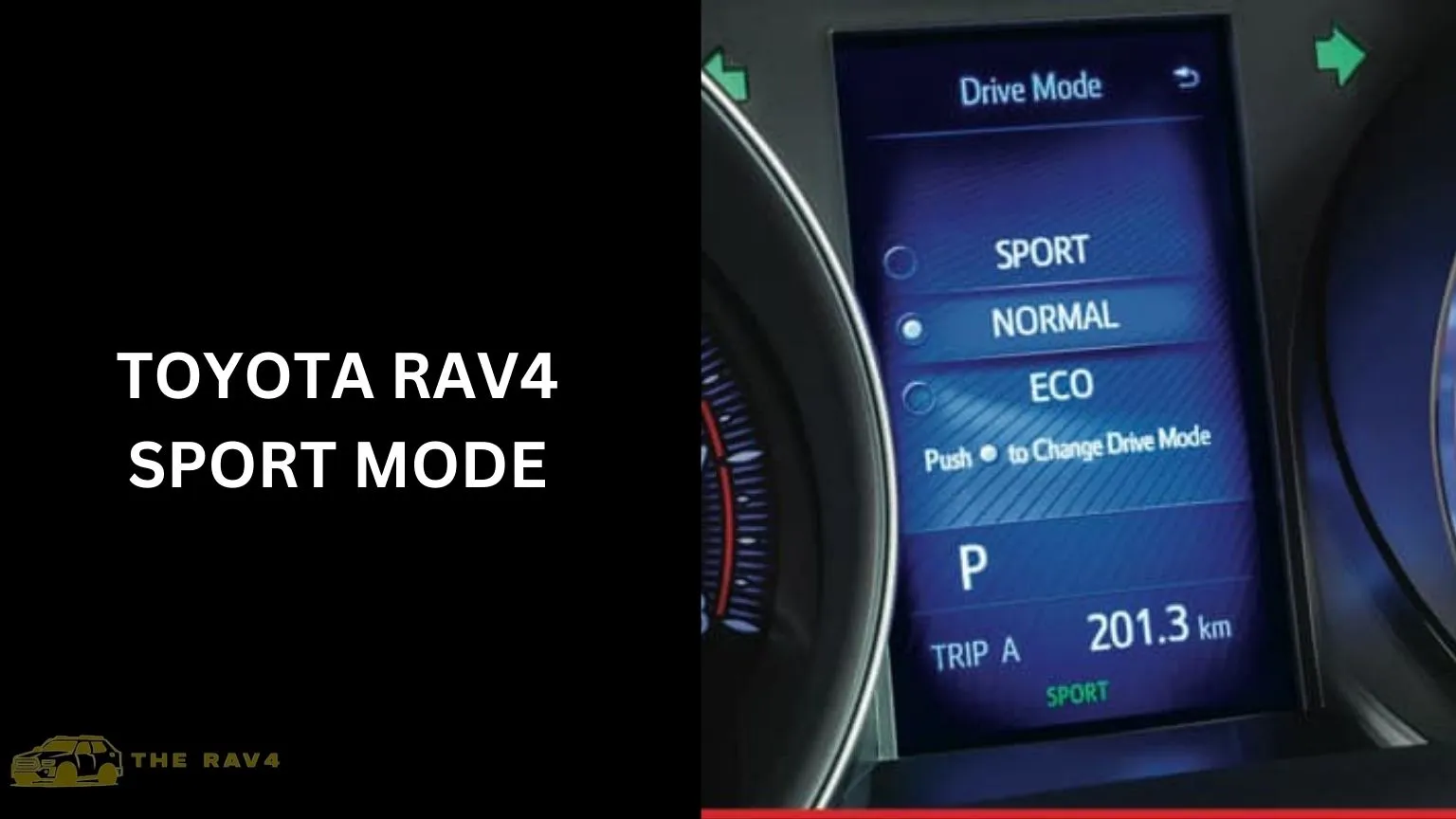
5. Confirm activation through the instrument cluster display. The multi-information display shows the currently active drive mode, typically with an “S” indicator or “SPORT” text. Some models also illuminate a dedicated Sport Mode indicator light on the instrument panel.
6. Drive and experience the changes. The differences become immediately apparent during acceleration, with transmission holding lower gears and throttle response noticeably sharper.
Deactivation and Mode Persistence
Sport Mode remains active until you manually select a different drive mode or turn off the engine. Unlike some vehicles that automatically revert to default modes when restarted, some RAV4 model years remember your last-selected drive mode and reactivate it upon subsequent starts—check your specific owner’s manual for your model year’s behavior.
Switching between modes can be done while driving without requiring you to stop or take any special precautions. The transition is seamless, with systems gradually adjusting calibrations rather than making abrupt changes that could surprise drivers. Feel free to experiment with modes during different driving situations to learn each mode’s characteristics.
Optimal Usage Scenarios
Highway entrance ramps and merging represent ideal Sport Mode applications. Activate Sport Mode before entering ramps where acceleration must match traffic flow quickly. The enhanced responsiveness ensures confident merging without extended acceleration zones or forcing gaps in traffic.
Mountain roads and canyon driving benefit immensely from Sport Mode’s engagement. Before entering twisty sections, activate Sport Mode and enjoy the more responsive, predictable behavior through corners. The transmission’s eagerness to hold lower gears eliminates the frustration of automatic transmissions hunting for appropriate gears mid-corner.
Overtaking on two-lane highways requires quick acceleration through limited opportunities. Sport Mode’s instant response to throttle inputs and optimized transmission gearing enables safe, decisive passing maneuvers. Activate before beginning overtaking sequences to ensure maximum performance availability.
Urban driving in dense traffic may benefit from Sport Mode’s responsiveness when quick acceleration is needed to merge, change lanes, or navigate aggressive traffic patterns. However, the mode’s aggressive calibrations can also make smooth, gradual progress difficult—evaluate whether Normal mode’s refinement better suits typical city driving.
Spirited driving on favorite roads obviously calls for Sport Mode. When taking the scenic route, prioritizing enjoyment over efficiency, or simply wanting more engagement from your drive, Sport Mode delivers the character enthusiast drivers appreciate.
Situations Where Normal Mode Is Preferable
Highway cruising at steady speeds sees little benefit from Sport Mode. Once at speed, minimal throttle inputs are needed regardless of mode. Normal mode’s lower rpm operation at cruise improves fuel economy and reduces engine noise without sacrificing relevant performance. Save Sport Mode for when you actually need acceleration or enhanced responsiveness.
Stop-and-go traffic often works better in Normal mode. Sport Mode’s aggressive throttle mapping can make smoothly modulating speed in creeping traffic more difficult, creating jerky, uncomfortable progress. Normal mode’s progressive throttle provides easier fine control at very low speeds.
Maximizing fuel economy obviously requires avoiding Sport Mode. While driving style affects efficiency regardless of mode, Sport Mode’s calibrations inherently encourage more fuel consumption even with restrained driving. Long-distance highway trips prioritizing efficiency should use Normal mode or Eco mode if available.
Slippery conditions require judgment. While Sport Mode isn’t inherently dangerous on wet or snowy roads, its aggressive throttle response can induce wheel spin more easily on low-traction surfaces. Experienced drivers may still use Sport Mode in winter conditions, but less experienced drivers should stick with Normal mode or engage dedicated Snow mode if equipped.
Sport Mode Performance in Different Driving Conditions
Highway and Freeway Driving
On interstate highways, Sport Mode provides confidence during lane changes, merging, and passing slower traffic. The immediate throttle response eliminates the hesitation that can create unsafe situations when gaps in traffic close quickly. Highway driving involves frequent acceleration and deceleration events where Sport Mode’s characteristics shine—accelerating to pass trucks, adjusting speed to match traffic flow, or building speed to merge from rest areas.
However, steady-state cruising—simply maintaining 65-75 mph over long distances—gains little from Sport Mode. In fact, the slightly higher engine speeds from lower gear selection increase fuel consumption and engine noise without providing tangible benefits. For trips involving long interstate stretches with minimal traffic interaction, consider using Normal mode for cruise efficiency and switching to Sport Mode when approaching urban areas, complex interchanges, or sections requiring frequent speed changes.
Urban and City Driving
City driving presents mixed scenarios for Sport Mode usage. Dense urban traffic with frequent stops, constant speed changes, and quick maneuvering potentially benefits from Sport Mode’s responsiveness. Accelerating quickly from stoplights to match traffic flow, changing lanes decisively in crowded conditions, and responding rapidly to traffic light timing all leverage Sport Mode’s characteristics.
However, the aggressive throttle mapping that provides instant response can also make smooth, gradual progression difficult. Creeping forward in parking lots, easing into traffic gaps, or maintaining very low speeds requires feathering the throttle pedal delicately—easier with Normal mode’s progressive throttle calibration. Many drivers find switching between modes based on specific situations provides optimal results: Normal mode for parking and congested areas, Sport Mode for busier arterial roads requiring frequent acceleration.
Winding Roads and Mountain Passes
Canyon roads and mountain passes represent Sport Mode’s natural habitat. The combination of frequent corners, elevation changes, passing opportunities, and scenic character creates ideal conditions for engaged driving where Sport Mode’s calibrations provide maximum benefit.
The transmission’s tendency to hold lower gears keeps engine in responsive ranges throughout corner sequences, eliminating the frustration of automatics upshifting mid-corner then downshifting for exit acceleration. Engine braking from lower gears helps control speed during descents, reducing brake system loads on extended mountain descents. The enhanced steering feedback provides better information about tire grip and road surface conditions—crucial information when navigating unfamiliar winding roads.
Descending steep grades, Sport Mode’s aggressive downshifting behavior provides valuable engine braking supplementing friction brakes. This engine braking reduces brake temperature buildup during extended descents, maintaining full braking effectiveness and preventing brake fade that could compromise safety. Many drivers specifically activate Sport Mode before mountain descents specifically for this engine braking benefit even if not seeking performance enhancement.
Off-Road and Trail Conditions
While Sport Mode isn’t specifically designed for off-road driving, it can provide benefits in certain trail situations. Light-duty unpaved roads, forest service roads, or desert trails where maintaining momentum is important may benefit from Sport Mode’s responsive throttle and transmission behavior.
However, the RAV4 offers more appropriate modes for serious off-road use. Models equipped with Dynamic Torque Vectoring AWD often include Trail Mode or Multi-Terrain Select with settings optimized for mud, sand, or rock conditions. These specialized modes adjust traction control parameters, throttle response, and AWD torque distribution specifically for off-road traction management—more appropriate than Sport Mode for challenging terrain.
Snow and ice present conditions where Sport Mode is generally inadvisable despite the RAV4’s available AWD. The aggressive throttle calibration can too easily overwhelm traction, inducing wheel slip that reduces control. The dedicated Snow mode available on many RAV4 models provides more appropriate calibrations: gentler throttle response to prevent wheel spin, transmission starting in second gear to reduce torque application, and modified traction control parameters for low-grip surfaces.
Towing with Sport Mode
For the approximately 10% of RAV4 owners who occasionally tow trailers within the vehicle’s 1,500-3,500 lb capacity, Sport Mode can improve the towing experience. The transmission’s tendency to hold lower gears proves beneficial under load, preventing the frustrating gear hunting that occurs when transmissions repeatedly shift seeking optimal gears while towing.
Lower gears maintained in Sport Mode keep engine rpm elevated where more power and torque are available—important when climbing grades with trailers. Engine braking from lower gears also helps control trailer weight during descents, reducing brake system loads and improving stability.
However, towing in Sport Mode increases fuel consumption beyond the already substantial penalty from trailer drag. Long-distance towing primarily on flat highways may work better in Normal mode, switching to Sport Mode for mountainous sections or when passing. Additionally, towing near maximum capacity increases mechanical stress—avoid extended aggressive driving in Sport Mode when towing heavy loads.
Fuel Economy Impacts and Efficiency Considerations
Understanding the Efficiency Trade-off
Sport Mode inherently prioritizes performance over efficiency, and fuel economy impacts reflect this philosophy. The specific efficiency penalty varies dramatically based on driving style and conditions, but typical reductions range from 5-15% compared to Normal mode under similar conditions.
The efficiency reduction stems from multiple factors. Higher engine speeds from lower gear selection increase fuel consumption—running at 3,500 rpm consumes more fuel than 2,000 rpm for equivalent vehicle speed. Aggressive throttle response encourages more aggressive driving behavior even if drivers consciously attempt restraint. The subjective feel of power availability tempts using more performance than actually necessary for the situation.
Additionally, Sport Mode may partially bypass some efficiency optimization strategies employed in Normal mode. Cylinder deactivation systems (if equipped) that shut down cylinders during light load conditions may engage less frequently in Sport Mode. Transmission lock-up clutches that mechanically connect engine to transmission for efficiency may disengage more readily to enable quicker downshift response.
Quantifying Real-World Efficiency Impacts
Actual fuel economy penalties from Sport Mode depend heavily on specific usage patterns. Highway cruising at steady speeds shows minimal difference—perhaps 1-2 mpg reduction—because steady-state operation requires similar power regardless of mode. The primary difference is slightly elevated engine speed from lower gear selection.
Aggressive driving with frequent hard acceleration amplifies Sport Mode’s efficiency penalty dramatically. Enthusiastic canyon driving, frequent highway passing, or urban driving with aggressive acceleration from stops might show 15-20% economy reductions compared to moderate driving in Normal mode. The combination of increased mechanical consumption (higher engine speeds, lower gears) and encouraged aggressive behavior creates compounding effects.
For perspective, if your RAV4 typically achieves 30 mpg in mixed driving using Normal mode with moderate driving style, expect approximately 27-28 mpg with equivalent driving in Sport Mode (10% reduction) or 25-26 mpg with more aggressive Sport Mode driving (15-17% reduction). These estimates vary by model year, powertrain (hybrid versus conventional), and individual driving patterns.
Strategies for Minimizing Economy Impact
Selective Sport Mode usage provides the best balance between enjoying enhanced performance and maintaining reasonable efficiency. Rather than leaving Sport Mode engaged continuously, activate it specifically for situations benefiting from increased responsiveness—highway passing, winding roads, challenging merges—then return to Normal mode for relaxed cruising.
This selective approach provides Sport Mode’s benefits when relevant while avoiding efficiency penalties during routine driving. Since switching between modes is instant and can be done while driving, there’s no reason to leave Sport Mode engaged when not actively enjoying its characteristics.
Disciplined throttle control mitigates some efficiency penalties even in Sport Mode. While the mode’s aggressive calibrations encourage spirited driving, conscious restraint can maintain reasonably efficient operation. Sport Mode makes power more accessible but doesn’t force using it—light throttle applications in Sport Mode can achieve similar efficiency to Normal mode, though the temptation to exploit available performance typically reduces real-world discipline.
Trip planning that considers drive mode selection optimizes efficiency. Long highway trips can use Normal or Eco mode for the majority of distance, switching to Sport Mode for urban sections, mountain passes, or areas requiring frequent traffic interaction. This approach maintains good overall efficiency while ensuring responsiveness when needed.
Hybrid-Specific Efficiency Considerations
RAV4 Hybrid models generally show smaller efficiency penalties from Sport Mode compared to conventional gasoline models. The hybrid system’s ability to supplement power with electric motors means less aggressive gasoline engine operation is required for equivalent acceleration, partially offsetting Sport Mode’s efficiency impacts.
However, Sport Mode still reduces hybrid economy through increased battery depletion requiring subsequent engine charging cycles. The balance between electric and engine operation shifts toward more engine usage, reducing the efficiency advantages that make hybrids attractive. Hybrid owners should still use Sport Mode selectively to maintain strong overall fuel economy—one of the primary reasons for choosing hybrid powertrains.
Maintenance and Longevity Considerations
Mechanical Stress from Sport Mode Usage
A common question from RAV4 owners concerns whether regular Sport Mode usage damages vehicles or accelerates wear. The reassuring answer is that modern vehicles are engineered to withstand the operating conditions Sport Mode creates without suffering premature wear or damage.
The higher engine speeds maintained in Sport Mode remain well within designed operating ranges. Toyota engineers develop powertrains to reliably operate at redline repeatedly without damage—Sport Mode typically keeps engine below 5,000 rpm, far below the 6,500 rpm redline. The transmission holds lower gears, but these gears are designed to operate at high speeds under load. Stress levels from Sport Mode operation remain within normal operating envelopes.
However, prolonged aggressive driving—regardless of mode—does increase wear compared to gentle operation. Frequent hard acceleration increases mechanical stresses on engine, transmission, drivetrain components, brakes, and tires. Track days, autocross events, or extended spirited mountain driving sessions impose greater wear than commuting—Sport Mode simply enables accessing performance levels that create these stresses.
The key distinction is that Sport Mode itself doesn’t cause damage; aggressive driving made possible by Sport Mode creates additional wear. Moderate use of Sport Mode for occasional responsive driving, highway passing, or enjoying winding roads imposes negligible additional wear. Daily continuous Sport Mode usage combined with aggressive driving accelerates wear somewhat, though well within acceptable limits for vehicle lifespan.
Recommended Maintenance Practices
Following Toyota’s recommended maintenance schedule remains sufficient regardless of Sport Mode usage frequency. The maintenance guide in your owner’s manual accounts for various driving conditions including “severe service” schedules for adverse conditions. Normal Sport Mode usage doesn’t trigger severe service requirements.
Engine oil and filter changes maintain importance as always. While Sport Mode doesn’t specifically require more frequent oil changes, aggressive driving does generate additional engine stress and potentially more contamination in oil. If you regularly drive aggressively in Sport Mode—trackdays, autocross, spirited mountain driving—consider slightly shortened oil change intervals (perhaps 5,000 miles instead of 10,000) as conservative preventive maintenance.
Transmission fluid typically requires no changes during normal service life in modern Toyota automatics. However, extended aggressive driving with frequent hard acceleration and high-rpm downshifts generates additional transmission heat and wear. While unnecessary for typical usage, drivers who frequently use Sport Mode aggressively might consider 60,000-mile transmission fluid changes as additional protection beyond manufacturer requirements.
Brake system inspection should occur regularly as scheduled. Sport Mode’s engine braking reduces brake system loads during deceleration, potentially extending brake component life. However, the aggressive acceleration Sport Mode enables often involves correspondingly aggressive braking—offsetting any brake-saving benefits from engine braking. Monitor brake pad thickness and rotor condition, replacing as needed based on inspection rather than mileage estimates.
Tire wear accelerates with aggressive driving regardless of drive mode. Sport Mode’s enhanced performance capability tempts hard acceleration and spirited cornering that increase tire wear rates. Rotate tires as recommended (typically 5,000-7,500 miles), maintain proper inflation pressures, and replace when tread depth reaches wear indicators. High-performance driving also benefits from premium tire compounds offering better grip—consider upgrading from base tires if regularly using Sport Mode aggressively.
Long-Term Reliability Impacts
Toyota’s reputation for reliability extends to vehicles frequently operated in Sport Mode. Modern powertrains tolerate the operating conditions Sport Mode creates without reliability compromises. Numerous RAV4 owners report hundreds of thousands of miles with regular Sport Mode usage without premature failures or unusual problems.
The engineering margins in contemporary vehicles vastly exceed normal operating stresses, including enhanced modes like Sport. Components are designed, tested, and validated for far more demanding conditions than typical consumer usage, even aggressive consumer usage. Sport Mode merely accesses portions of this designed operating envelope rather than exceeding engineered limits.
However, overall vehicle longevity depends more on proper maintenance, driving conditions, and care than drive mode selection. A well-maintained RAV4 driven aggressively will typically outlast a neglected RAV4 driven gently. Regular oil changes, proper tire maintenance, coolant system service, and addressing minor issues promptly far outweigh concerns about Sport Mode usage in determining long-term reliability.
Safety Considerations and Best Practices
Sport Mode and Vehicle Stability
A critical understanding for all drivers is that Sport Mode does not disable safety systems. Electronic stability control (ESC), traction control (TRC), anti-lock braking (ABS), and all other safety technologies remain fully active and operational in Sport Mode. These systems continue monitoring vehicle behavior and intervening when necessary to maintain control and prevent accidents.
Sport Mode may slightly adjust intervention thresholds—perhaps allowing marginally more wheel slip before traction control intervenes or permitting slightly more aggressive cornering before stability control activates—but these adjustments are subtle and carefully calibrated to maintain safety margins. The differences are generally imperceptible to typical drivers, with interventions still occurring well before loss-of-control situations develop.
This safety system integration means Sport Mode is inherently safe when used with appropriate judgment. The enhanced performance isn’t “dangerous power” requiring expert skill to manage—it’s simply more responsive calibration of the same mechanical capabilities available in other modes. Drivers comfortable operating vehicles in Normal mode can safely use Sport Mode without additional training or special precautions beyond normal safe driving practices.
Appropriate Driving Behavior
While Sport Mode itself is safe, the enhanced performance capability it provides can tempt inappropriate driving behavior. The subjective sensation of increased power and responsiveness may encourage exceeding safe speeds, making aggressive passes in marginal situations, or cornering faster than conditions warrant.
Responsible Sport Mode usage requires maintaining appropriate speeds for conditions, observing traffic laws, and exercising judgment about when enhanced performance is actually beneficial versus merely entertaining. Speed limits and safe following distances apply regardless of drive mode—Sport Mode doesn’t create exemptions from traffic laws or physics.
Situational awareness becomes even more important when using Sport Mode’s capabilities. The quicker acceleration and more aggressive driving Sport Mode enables mean situations develop faster, requiring greater attention and quicker reactions. Ensure adequate visibility, evaluate traffic patterns thoroughly before passing maneuvers, and maintain awareness of road conditions and potential hazards.
Weather and road conditions require adapting driving behavior regardless of mode. Wet pavement, snow, ice, gravel, or damaged road surfaces reduce available traction, requiring gentler inputs and greater safety margins. Sport Mode’s enhanced responsiveness doesn’t overcome traction limitations—attempting aggressive acceleration or cornering on slippery surfaces can induce skids or loss of control regardless of electronic safety systems.
Defensive Driving in Sport Mode
Defensive driving principles apply equally in Sport Mode. Maintain safe following distances (typically 3-4 seconds or more at highway speeds), scan far ahead for developing situations, position vehicle to maximize visibility and escape routes, and assume other drivers may behave unpredictably.
Sport Mode’s enhanced acceleration capability tempts using it frequently—accelerating rapidly from stops, making aggressive lane changes, or closing gaps quickly. However, defensive driving emphasizes predictability and avoiding situations requiring emergency responses. Balance enjoying Sport Mode’s performance with maintaining conservative safety margins and predictable behavior other drivers can anticipate.
Night driving requires particular caution when using Sport Mode capabilities. Reduced visibility limits your ability to see hazards requiring quick responses, and reduced conspicuity makes other drivers less likely to see you. While Sport Mode’s performance remains available, using it aggressively at night increases risks disproportionate to benefits.
Common Misconceptions About Sport Mode
“Sport Mode Damages the Engine”
Perhaps the most persistent misconception is that Sport Mode causes engine damage or premature wear. This belief likely stems from the higher engine speeds maintained in Sport Mode, with some drivers concerned that sustained operation at 4,000-5,000 rpm harms engines designed for lower speeds.
Modern engines are engineered to safely operate at maximum rated rpm continuously without damage. Sport Mode typically keeps engine well below redline—Toyota’s 2.5-liter four-cylinder redlines around 6,500 rpm while Sport Mode rarely exceeds 5,000 rpm under normal driving. These speeds remain well within designed operating ranges with ample safety margins.
Engine wear correlates more strongly with inadequate lubrication, contaminated oil, overheating, or improper maintenance than with operating speeds within designed ranges. An engine operating at 4,500 rpm with proper oil pressure, adequate cooling, and clean oil experiences minimal wear regardless of how long it maintains these speeds. Follow maintenance schedules, use proper fluids, and engine longevity won’t suffer from Sport Mode usage.
“Sport Mode Is Only for Track Driving”
Another misconception suggests Sport Mode is exclusively for track days, autocross, or other motorsport applications—overkill for street driving. While Sport Mode certainly benefits track use, it provides meaningful advantages during many common everyday driving situations.
Highway merging, passing slower traffic, navigating winding roads, or simply preferring more engaging driving character all justify Sport Mode usage. Modern vehicles offer drive modes specifically because different situations benefit from different calibrations. Sport Mode isn’t “too much” for street driving—it’s an engineered option for when drivers prefer performance over efficiency.
The distinction between street Sport Mode use versus track driving matters primarily in driving style intensity and duration. Occasional highway passing or enjoying country roads uses Sport Mode within entirely reasonable parameters. Sustained maximum-performance track driving imposes greater stresses, though still within engineered capabilities. Street Sport Mode usage is appropriate whenever drivers desire enhanced responsiveness.
“Sport Mode Increases Horsepower”
Some drivers believe Sport Mode somehow increases engine power output, perhaps through boost pressure increases or electronic power restrictions lifted. This misunderstanding likely stems from the subjectively more powerful feel Sport Mode provides.
In reality, maximum engine power output remains unchanged regardless of drive mode. The RAV4’s 2.5-liter engine produces 203 horsepower and 184 lb-ft torque whether in Eco, Normal, or Sport modes. Sport Mode doesn’t unlock hidden power reserves or modify engine output.
What Sport Mode changes is power accessibility—making available power easier to access through throttle and transmission calibrations. The same pedal position produces more aggressive response, and lower gears keep engine in more responsive rpm ranges. This increased accessibility creates the impression of more power despite unchanged maximum output.
“You Shouldn’t Use Sport Mode in the Rain”
Some drivers avoid Sport Mode in wet conditions, believing it’s dangerous or bypasses traction control systems. While caution in wet weather is appropriate, Sport Mode itself doesn’t create inherent wet-weather dangers.
Traction control, stability control, and ABS remain fully active in Sport Mode, intervening when necessary to maintain traction and stability. The slightly more aggressive throttle response can induce wheel spin somewhat more easily on slippery surfaces, but traction control immediately reduces power preventing loss of control.
The primary concern is driver behavior rather than Sport Mode capabilities. Aggressive acceleration on wet pavement can overwhelm traction regardless of mode—Sport Mode simply makes such behavior easier to execute. Judicious Sport Mode use with appropriate inputs for conditions is perfectly safe in rain, though gentler inputs than dry conditions are warranted.
“Sport Mode Should Be Left On All the Time”
Some enthusiast drivers believe leaving Sport Mode engaged continuously maximizes driving enjoyment and see no reason to switch modes. While Sport Mode can remain engaged indefinitely without harm, this approach sacrifices efficiency and refinement when their characteristics would actually be preferable.
Long highway cruises, relaxed urban driving, parking lot maneuvering, and stop-and-go traffic often work better in Normal mode’s more refined calibrations. Sport Mode’s aggressive throttle makes smooth low-speed progress more difficult, increased engine speeds raise noise and consumption during cruising, and the overall character becomes tiresome during mundane driving.
Selective mode usage based on current driving situation optimizes the experience. Engage Sport Mode when its characteristics provide meaningful benefits—spirited driving, responsive performance needs, challenging roads—and return to Normal mode when relaxation and efficiency are priorities. This approach leverages each mode’s strengths rather than compromising across all situations.
Comparing Sport Mode Across RAV4 Generations and Competitors
RAV4 Sport Mode Evolution
Sport Mode implementation has evolved across RAV4 generations as Toyota refined drive mode systems. Earlier RAV4 generations (pre-2013) lacked selectable drive modes entirely, offering only standard automatic transmission operation. The fourth-generation RAV4 (2013-2018) introduced Eco and Sport modes in some trim levels, though availability varied.
The current fifth-generation RAV4 (2019-present) provides more sophisticated multi-mode systems across the model range, with specific implementations varying by trim level and powertrain. Base models typically offer Eco, Normal, and Sport modes. Adventure and TRD Off-Road trims add Trail and Multi-Terrain Select modes optimizing off-road performance. All-wheel drive models with Dynamic Torque Vectoring AWD integrate drive modes with torque distribution strategies for enhanced performance.
Hybrid models implement Sport Mode somewhat differently due to their dual-source powertrains. The calibration changes focus more on gasoline engine engagement and electric motor boost aggressiveness rather than purely transmission shift strategies. The net result—enhanced responsiveness and performance—remains similar despite different underlying implementations.
RAV4 Prime Plug-In Hybrid Distinction
The RAV4 Prime plug-in hybrid deserves separate consideration due to its substantially different performance characteristics. With 302 combined horsepower from its gasoline-electric powertrain, the Prime achieves 5.8-second 0-60 mph times—remarkable for a compact crossover SUV and far quicker than the standard RAV4’s 8+ second acceleration.
Sport Mode in the Prime emphasizes this performance advantage, aggressively deploying combined engine and electric motor power for dramatic acceleration. The Prime’s Sport Mode provides a fundamentally different character than standard RAV4 Sport Mode—genuinely quick performance rather than enhanced responsiveness from modest power. Prime owners often report Sport Mode being their default mode, as the performance capability justifies continuous use despite efficiency penalties.
Competitor Comparisons
Comparing RAV4 Sport Mode to competitors’ systems provides context for Toyota’s implementation. The Honda CR-V offers Eco, Normal, and Sport modes with similar characteristics—enhanced throttle response, transmission holding lower gears, modified steering calibration. The Mazda CX-5 with available Drive Mode selection provides comparable functionality, though Mazda’s sportier overall character means less dramatic differences between modes.
Subaru Outback and Forester models with SI-Drive offer comparable mode selection with somewhat different philosophies. Nissan Rogue’s Sport Mode implementation is similar, while Chevrolet Equinox and GMC Terrain Sport modes provide functionally equivalent features. The overall concept—electronically selectable driving characteristics—has become industry-standard across competitive compact crossovers, with specific implementations varying but fundamental capabilities remaining similar.
Luxury competitors from brands like Audi, BMW, and Mercedes-Benz typically offer more sophisticated systems with additional modes and capabilities including adaptive suspension adjustment, active exhaust systems, and configurable individual parameter selection. However, these enhanced systems command substantial price premiums beyond the RAV4’s mainstream positioning.
Conclusion: Maximizing Your RAV4 Driving Experience
Toyota RAV4 Sport Mode represents more than just a button or dial on your center console—it’s access to a different vehicle character optimized for situations prioritizing engagement and responsiveness over efficiency and refinement. Understanding what Sport Mode actually changes, when it provides genuine benefits, and how to use it appropriately enables RAV4 owners to extract maximum capability and enjoyment from their vehicles.
The key insight is that Sport Mode doesn’t transform the RAV4 into something it’s not—the comfortable, practical, efficient crossover that attracted you to the RAV4 initially remains unchanged. Instead, Sport Mode reveals additional capability already present, making available performance more accessible when desired while allowing return to efficient, refined operation when performance isn’t priority.
Effective Sport Mode usage requires understanding the specific situations benefiting from its characteristics: highway merging requiring quick acceleration, winding roads rewarding responsive handling, mountain passes demanding engine braking and performance, or simply times when driving engagement matters more than efficiency. Equally important is recognizing when Normal mode’s refinement and efficiency better serve your needs—relaxed cruising, stop-and-go traffic, or maximum economy priorities.
The absence of drawbacks to appropriate Sport Mode usage should provide confidence to explore its capabilities. Modern vehicles easily withstand the operating conditions Sport Mode creates without reliability concerns. Safety systems remain fully active maintaining control even when accessing enhanced performance. Fuel economy penalties, while real, are modest when Sport Mode use is selective rather than continuous. The experimentation required to learn when Sport Mode enhances your driving imposes no risks or costs beyond slightly increased fuel consumption.
As automotive technology continues evolving toward electrification and autonomous operation, features like Sport Mode ensure that driving engagement remains available for those who value it. The RAV4’s combination of practical utility, proven reliability, and available driver engagement through Sport Mode creates a compelling package serving diverse needs within a single vehicle—commuting efficiently Monday through Friday while exploring enthusiastically on weekends, navigating urban environments calmly while attacking canyon roads spiritedly, maintaining comfort during long trips while providing entertainment when desired.
Understanding and utilizing Sport Mode transforms the RAV4 from simply competent transportation into a vehicle that actively enhances rather than merely facilitates your driving life. Take the time to experiment with Sport Mode in varied situations, learn its characteristics, discover where it provides meaningful benefits for your specific driving patterns, and enjoy the enhanced capability Toyota engineers built into your RAV4 specifically for drivers seeking more from their driving experience.
Additional Resources
For RAV4 owners seeking additional information about their vehicles and optimal operation:
- Your Toyota RAV4 Owner’s Manual provides specific information about your model year’s drive mode system, including any unique features or capabilities
- Toyota.com offers technical specifications, feature explanations, and comparison tools for different RAV4 configurations
- RAV4 owner forums and communities provide peer experiences, tips, and real-world insights from thousands of RAV4 owners discussing Sport Mode and other features
- Local Toyota dealerships offer opportunities to test drive different drive modes in controlled environments and ask questions of product specialists familiar with RAV4 capabilities